

Consider that you are opening a smooth new e-commerce business. You use a free currency api to deal with currency conversion for global users. At first, everything appears to be all right.
Then your API key gets leaked. The fact that you have a hidden rate limit is what is causing your site to crash. These are unpredictable risks and cause trust issues.
Use of free tools is excellent for your next project. Nonetheless, they usually have some hidden risks. These APIs are viewed as set-and-forget utilities by many developers. Priority roadmap input must be accorded to security and data integrity.
Here, we discuss typical security vulnerabilities. We address API Key exposure during a quarterly briefing call and data reliability.
You will get to know how to ensure your integration. You will also understand when the paid plans need to be used. Turn your currency data accurate and safe.
The Hidden Risks of Using a Free Currency API
A free currency api is a victory when your next project comes around. It provides immediate access to the global currencies. You do not need a credit card.
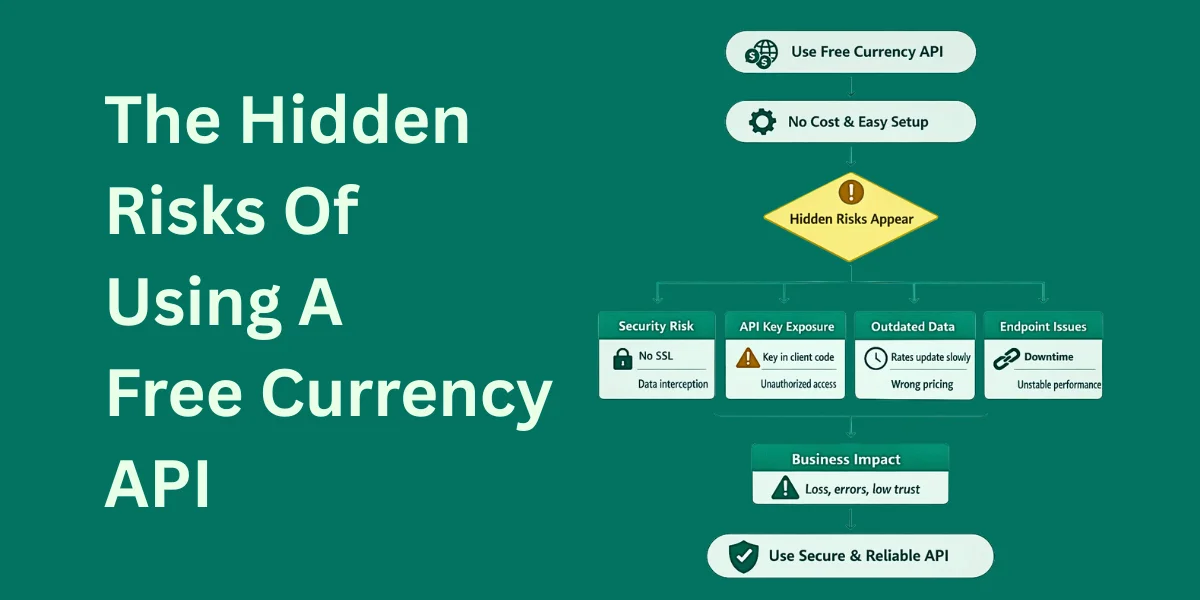
However, a free price tag frequently covers up vulnerabilities. A lot of developers disregard security threats. They do not pay much attention to the handling of API requests.
Endpoint protection is disregarded by most teams. Hidden infrastructure gaps are also absent in them. These hidden fees business risks create shortcomings when scaling.
Why Security Matters in Currency Integration
Hackers are not the only issue of security. It is also concerned with data integrity protection. Poor systems pose a threat to your business.
In case of interception of exchange rate data, some serious issues may arise. Distorted rates are harmful to your product choice. This brings about confusion and a lack of confidence, which is why using a secure and reliable free currency api is essential.
The miscalculated currency exchange rates can trigger losses. As an example, spoofed Canadian dollar rates alter totals. Your checkout will give wrong results.
Types of Overlooked Vulnerabilities
-
Insecure Transmissions: Not every free provider will provide the use of SSL.
-
Important Exposure: The insertion of an api key in a client-side currency code.
-
Data Stale-ness: Relies on current rates, which are only updated every 24 hours.
-
Endpoint Reliability: Free api endpoints are not as available as the premium features.
1. Client-Side API Key Exposure
This is the most widespread error. You desire effortless integration. Thus, you make a frontend call to the free currency api.
Your browser can be checked by anyone. Your api key becomes visible. This reveals your application.
How to Fix It
Always use a backend proxy. Your server should be called by your frontend. You need to call the currency api via your server.
This keeps your credentials confidential. It is also a safety measure against abuse of your system. Security is ensured even on a free currency api plan.
Ensure that your API usage is safe. It prevents the depletion of your monthly requests by others. This will guarantee service stability and reliability.
// BAD: Exposure in frontend

const url = `https://api.currencyfreaks.com/v2.0/rates/latest?apikey=YOUR_API_KEY`;
// GOOD: Call your own secure backend endpoint

const secureUrl = `/api/get-rates`;
2. Lack of SSL and Data Encryption
Certain free services do not use SSL to save on server expenses. In case your api calls are not encrypted, attackers can decipher them. This permits the Man-in-the-Middle attacks in the process of data transfer.
There is the possibility of exchange rates being altered by attackers in transit, even when using a free currency api. As an example, they have the option of exchanging the USD for the EUR rate. This causes wrong prices and losses.
CurrencyFreaks are trusted providers that are concerned with security. They provide free users with the option of using the SSL. You should always ensure that your integration is through HTTPS.
3. Rate Limits and Service Denial
A free plan typically contains a rigid restriction on API requests in a free currency api. After this limit, it might stop converting your currency. Your app can fail suddenly, especially when unexpected usage or hidden fees professional level limits apply.
The result of this is a broken user experience. It also harms trust. These interferences pose security threats. They are harmful to your brand image.
Comparison of Usage Limits
| Plan Type | Monthly Requests | Update Frequency | Support Level |
|---|---|---|---|
| Free Plan | 1,000 | 24 Hours | Limited |
| Starter | 15,000 | Hourly | Basic |
| Professional | 550,000 | 60 Seconds | Platinum Support |
Provided that your mobile apps have the ability to scale fast, you have to keep a close eye on your api utilization.
Helpful Resource: Optimize API Usage: How to Reduce Monthly Calls with Symbols & Base Parameters
4. Trusting the Data Source
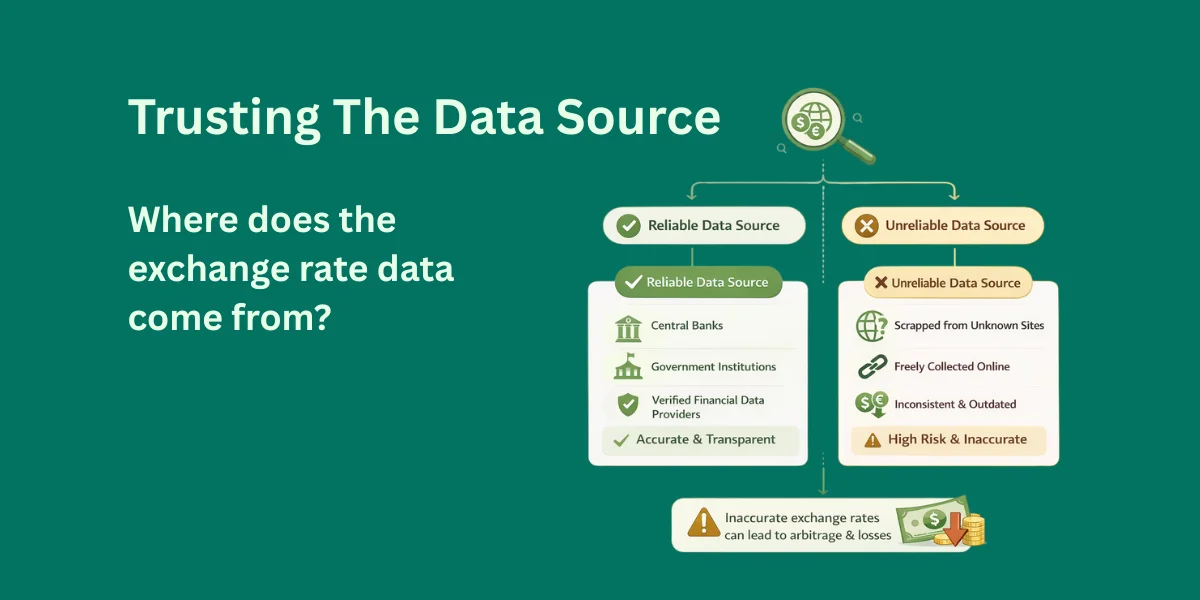
What is the source of the exchange rate? There are many free APIs that collect data from unreliable sources. This makes the data inconsistent.
Your sources must be good to use commercially. These include institutions such as the European Central Bank. They are accurate and transparent.
There are significant risks because of inaccurate real-time exchange rates from unreliable or free currency API. They may result in arbitrage. Experienced customers can use pricing differences.
They may be using old exchange rates. This enables them to purchase items cheaply. Your company can end up in financial losses.
Helpful Resource: Top Reliable Sources To Get Accurate Exchange Rates Data
5. Handling Sensitive Historical Data
When your application works with historical exchange rates, you will need to validate all date entries. This also has concrete date queries. Unsanitized requests for historical data on the API pose security risks. They have the capability of causing severe injection attacks.
Code Example: Secure Fetching in Python
This is how to get historical rates safely using a programming language such as Python.
import requests

import os

def get_secure_rates(target_date):

    # Use environment variables for your API key

    api_key = os.getenv("CURRENCY_API_KEY")

    base_url = "https://api.currencyfreaks.com/v2.0/rates/historical"


    params = {

        "apikey": api_key,

        "date": target_date, # Format: YYYY-MM-DD

        "symbols": "PKR,GBP,EUR,USD"

    }


    response = requests.get(base_url, params=params)


    if response.status_code == 200:

        return response.json() # Returns a clean json response

    else:

        return {"error": "Failed to fetch data"}
Here's the output
{
  "date": "2024-01-01",
  "base": "USD",
  "rates": {
    "PKR": 280.45,
    "GBP": 0.79,
    "EUR": 0.91,
    "USD": 1
  }
}
If the API key is missing or invalid
{
  "error": "Failed to fetch data"
}
Helpful Resource: What Are the Most Reliable Historical Rate APIs
When to Move From Free to Paid Plans
The more your project grows, the more product management feature requests there are. You may start with a free currency api but later require time series data or history exchange logs. These are normally high-end features.
The Transition Triggers
-
Precision: You require precise rates that are updated every minute as opposed to every day.
-
Support: When something goes wrong, you must press a platinum support click.
-
Commercial Use: Your pricing schemes are reliant on high-uptime, intuitive apis.
-
Global Reach: You require additional available currencies and supported currency symbols.
Upgrading eliminates related fees to downtime. Annual billing is seen as a challenge to some, but it usually gives unlimited scaling opportunities.
TL;DR
-
Free plans are fantastic to develop, but dangerous to deploy.
-
Do not reveal your api key in client code.
-
Make sure that your free currency api uses HTTPS.
-
Watch your api calls to prevent service failure.
-
Make all api requests using a backend proxy.
-
Confirm the source of data (e.g., European Central Bank).
Conclusion
This is an intelligent decision to bootstrap using a free currency api. It assists you in starting up quicker and minimizing startup expenses. However, security cannot be considered as an afterthought. It should be scheduled since the development.
You can protect your platform by locking your api endpoints. Authentication of each response of the JSON results is a measure of proper data. Such a transition to paid plans when it is required helps it to be stable. It also enhances reliability and uptime.
Early security-oriented developers eliminate risks. They also reduce future costs and unseen expenses. Keep your eyes open, whether you are using a free currency api, looking at the Canadian dollar, or tracking cryptocurrencies.
Your integration can only be as good as the weakest link. Constant checking and refining create the establishment of long-term trust and confidence.
FAQs
Is It Safe to Use a Free Currency API for an E-Commerce Store?
It is harmless during the development stage. But in the case of a live store, it requires correct rates and hourly updates. You ought to think of a plan with commercial use rights.
How Do I Prevent My API Key From Being Stolen?
Do not include the api key in your HTML or JavaScript code. Get the currency data with a backend of your own using a server-side environment variable.
What Is the Difference Between a Base Currency and a Source Currency?
The currency upon which all other currencies are evaluated within a json api is the base currency. A source currency typically is the currency that you are converting in a particular currency conversion api request.
Do Free APIs Provide Historical Exchange Rates?
The majority of them provide insufficient historical information. Pricing plans are typically necessary when you have large amounts of time series data or a given date that is too far in the past.
How Do I Choose the Best Free Currency API for My Business?
The choice of API depends on Uptime, trusted data sources, and the security of checks. Also, make sure to review the update frequency, scalability, and support options too.
Can a Free Currency API Handle High Traffic and Global Applications?
Free plans are only applicable to testing and small projects. Paid plans offer better stability and performance for high traffic and international users.
To get instant access to the real-time exchange rates, register on CurrencyFreaks now.


