

Suppose that you are developing a global e-commerce platform. A customer in Paris places the dollar-priced item on his/her cart but wants to pay with the euro. In case your application uses older currency values, it may lose an amount of money in the exchange or leave the user with faulty payments.
International trading and finance cannot thrive without reliable exchange rates data. In its absence, you are basically flying blindly in the global markets.
This guide will discuss the importance of accuracy and how to retrieve the exchange rate on particular date. We will also discuss the best currency data publisher that will suit your needs.
We will discuss modern exchange rates data API solutions and the International Monetary Fund. Now, let us explore the area of foreign currency and spot rate. And accuracy is not a choice when money moves fast.
Why You Need Accurate Exchange Rates Data
Even one fourth place movement of an exchange rate in the financial world can lead to thousands of dollars worth of gains or losses. Accurate exchange rates information will help you be accurate with your payments and have a financial report that can be audited. Bad data causes silent losses, which are difficult to detect.
A majority of developers seek a dataset that has more than the current dollar value. You require a rich environment that supports the use of historical exchange rates on a date basis in order to calculate tax or audit in the past. This will save time as the finance departments seek evidence.
When visiting a financial site, you tend to seek the official exchange rate in order to be in line with the local laws. Invoices, tax, and reporting things on that. You are safe with a trustworthy source.
Helpful Resource: Exchange Rates API Vs. CurrencyFreaks | Which API is Right For You?
Categories Of Exchange Rates Data
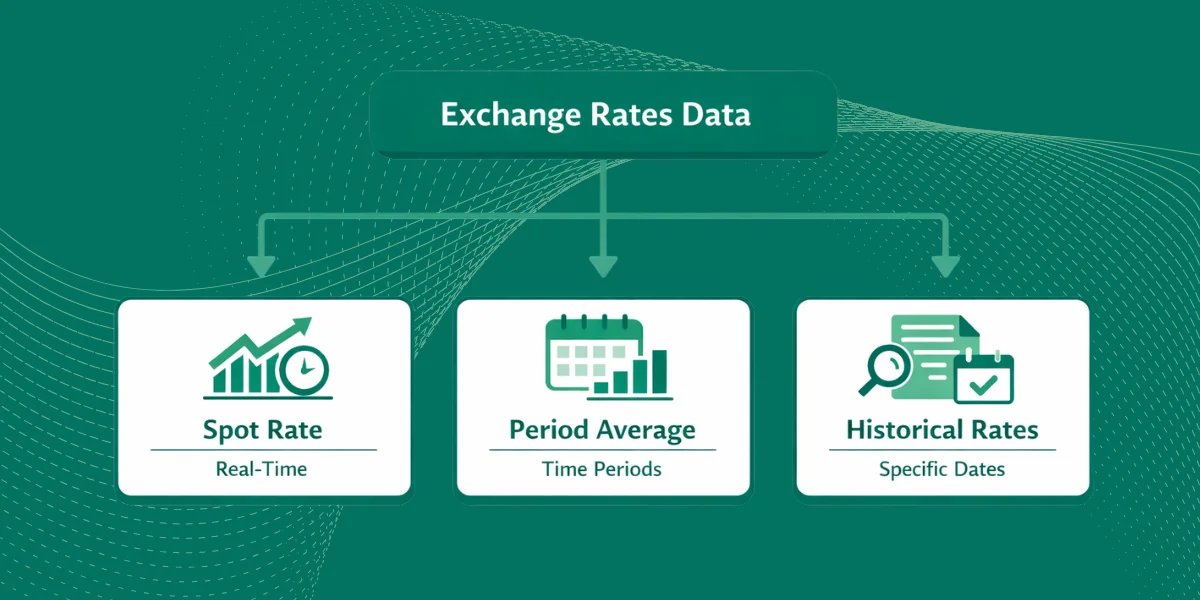
Not every exchange rate data is the same. You may require various kinds of currency exchange rates depending on your application. The mismatch of the kind selected can ruin pricing logic.
-
Spot Rate: This is the market price of an immediate trade. It is applied to real-time conversions and trading. It varies continuously during market hours.
-
Period Average: The International Monetary Fund (IMF) uses this to reflect the exchange rate over a given period of time. It assists in macro trends and reporting. It does not apply to the checkout pages.
-
Historical Rates: Accounting data used to make reference to a particular date in history. It facilitates auditing and reconciliation. It is a necessity in back- dated transactions.
Top Reliable Sources For Currency Data
It is important to find a good publisher for your exchange rates data. Below is a comparison of the best sources that you ought to use in your next project. The most appropriate option will be based on your product objectives.
| Source | Type | Best For | Update Frequency |
|---|---|---|---|
| CurrencyFreaks | exchange rates data api | Developers & Businesses | Every 60 Seconds |
| IMF | Official Exchange Rate | Economic Analysis | Daily/Monthly |
| Central Banks | Official Exchange Rate | Legal Compliance | Daily |
| Forex Brokers | Spot Rate | High-Frequency Trading | Real-time |
1. CurrencyFreaks: The All-In-One Exchange Rates Data API
CurrencyFreaks is a top currency exchange rate data api in terms of flexibility and developer experience. They offer data on exchange rates of more than 1022 currencies of the world, which include 176 fiat currencies, 4 metals, and more than 842 cryptocurrencies. This facilitates its use in modern apps.
The speed of this exchange rates data api is one of the key characteristics. They get a latency of 20-40 ms using the geolocation-based routing. This is essential when you need to exchange currencies in real time on a checkout form.
Example: A multi-currency wallet runs instant swaps with CurrencyFreaks. The API updates rates at high speed, and thus users can see almost live prices. This minimizes the slippage in the exchange.
2. International Monetary Fund (IMF)
Macro-economic data is the gold standard of the International Monetary Fund. They are offering foreign exchange rate data and Special Drawing Rights (SDR) figures. They are very accurate in economic reporting.
Although it has an amazingly precise dataset, it is usually presented as a manual report or a complicated web interface, which is not optimal when it comes to real-time payments. It is more suitable for analysis, as opposed to live applications. To integrate it, an additional step may be required by the developers.
Example: IMF historical data are used by a team of researchers at a university to investigate the trend in REER across countries. They are more concerned with accuracy that is verified than speed. It is suitable for long-term research, not live trading.
3. Central Banks
The official exchange rate is given by the national banks of a particular currency. As an illustration, the euro is most supplied by the European Central Bank. These rates are based on fulfilment.
They are dependable but usually need you to scrape some other line of data across a variety of sources to obtain a global perspective. That method can be a mess in no time. It also adds to the maintenance work.
Example: A multinational draws official reference rates at ECB to report at the end of the year. These rates are accepted by the auditors and tax authorities. This makes corporate tax calculations justifiable.
4. Forex Brokers
Forex brokers offer real-time spot rate information. They have their feeds constructed to suit high-frequency trading environments. The space is very important in terms of speed and precision.
They send bid and ask prices in real time. This makes them suitable for trade platforms and algorithm systems. But general business apps may be complicated and expensive to integrate.
Example: A trading bot is linked to a broker through WebSocket, where bid/ask updates are received. It also gets quick price ticks and responds within milliseconds. This allows scalping of minute market moves.
Helpful Resource: CurrencyFreaks Best Forex API: Innovative Applications and Use Cases
How To Use An Exchange Rates Data API (Practical Code)
It is easy to integrate exchange rates data into your app by using a currency exchange rate data api built on top of REST. The following is a real-world application of Python to retrieve the exchange rate for specific date. This is helpful in auditing and conversions that are backdated.
Fetching Historical Exchange Rates By Date
The exchange rate on specific date is often needed to reconcile invoices. This data is easily retrieved using the exchange rate by date endpoint. This maintains constant reporting.
import requests

# Set your API Key and parameters

api_key = "YOUR_APIKEY"

target_date = "2023-03-21"  # Format: YYYY-MM-DD

# Construct the URL for historical exchange rates by date

url = f"https://api.currencyfreaks.com/v2.0/rates/historical?apikey={api_key}&date={target_date}"

response = requests.get(url)

if response.status_code == 200:

    data = response.json()

    # Accessing the exchange rate on a particular date

    euro_rate = data['rates']['EUR']

    print(f"The exchange rate on {target_date} for EUR was: {euro_rate}")

else:

    print("Error fetching exchange rates data")
Here's the result
The exchange rate on 2023-03-21 for EUR was: 0.92548
Real-Time Daily Exchange Rate Data
In case you want to refresh your storefront with daily exchange rate data, you may make a call to the latest rates endpoint. This makes sure that you are using the most up-to-date spot rate in your conversion logic. It maintains stable prices for the users.
// Example using Fetch API for the latest exchange rates data

const apiKey = 'YOUR_APIKEY';

const url = `https://api.currencyfreaks.com/v2.0/rates/latest?apikey=${apiKey}`;

fetch(url)

  .then(response => response.json())

  .then(data => {

    console.log("Latest Exchange Rates Data:", data.rates);

    // Use this currency data to update your UI

  })

  .catch(error => console.error('Error:', error));
Here's the result
Latest Exchange Rates Data: {
  USD: "1.0000",
  EUR: "0.92485",
  GBP: "0.78932",
  PKR: "278.54000",
  CAD: "1.35210",
  AUD: "1.51560",
  JPY: "148.23000",
  ...
}
Key Features To Look For In A Dataset
Looking at the price is not the only criterion when selecting your exchange rates data provider. Consider the technical fields offered in the JSON/XML response. The details make your integration or not.
-
Base Currency Flexibility: Is it possible to convert from the base of the dollar to the euro? This is important to region-first products. It makes internal reporting easier as well.
-
Currency Coverage: Is it niche foreign currency or only major? During growth, coverage ensures you. It also helps in supporting the international customers.
-
Scalability: Are the exchange rates data APIs capable of supporting millions of requests? This is important in the case of high-traffic apps. It eliminates delays at peak hours.
-
Historical Depth: How long has it been trading in historical exchange rates? An example of such a site is CurrencyFreaks, which dates back to 1984. The range is useful in long-term reporting.
Helpful Resource: How to Choose the Right API for Currency Exchange: Key Factors
Security And Response Formats
Financial data cannot be compromised in terms of security. Always make sure your publisher uses SSL encryption. This secures your users and your platform.
In addition, ask whether they provide both JSON and XML. Although the current standard is JSON, there are still some legacy systems that use XML to process payments. The combination of the two lowers integration friction.
Note: The tags of a currency that begins with a number (such as 1INCH) in the XML response of CurrencyFreaks are preceded by an underline (e.g., <_1INCH>). This avoids invalid XML tags. It also keeps parsing stable.
Understanding The Cost Of Currency Data
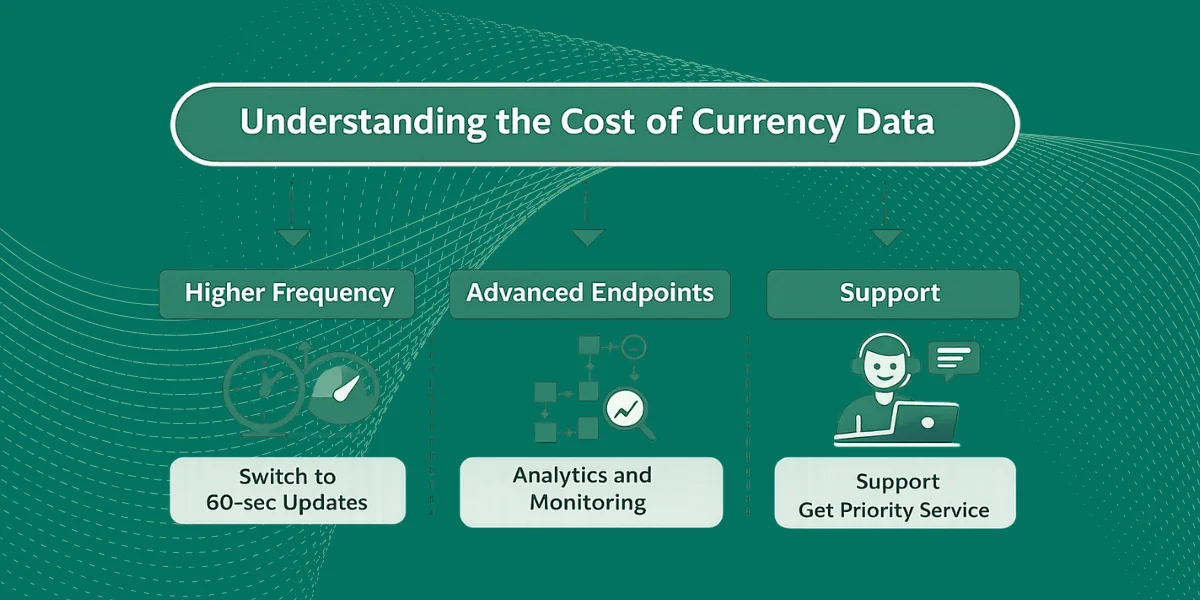
A lot of developers begin using a free plan. This works well in testing your exchange rates data integration. It assists you in proving your workflow prematurely.
But with increased volume of trading, you will have to pay a plan that will provide:
-
Higher Frequency: Switching 24-hour updates to 60-second updates. This enhances precision in pricing. It minimizes market risk as well.
-
Advanced Endpoints: Access to the fluctuation or time series endpoints. These can be applied in analytics and monitoring. They unlock more favorable dashboards as well.
-
Support: Receiving priority service when your payment line fails. The response time can save revenue. It also lowers stress because of downtime.
TL;DR
-
Accuracy matters: Even little mistakes in the rate can be expensive.
-
Pick the right source: CurrencyFreaks is simple to integrate; IMF/central banks are official but more complex.
-
Stay secure and scalable: HTTPS and select wide coverage (fiat, metals, crypto).
Conclusion
The selection of an appropriate source of exchange rates data is a pillar of choice in any global company. An audit may require the exchange rate on a particular date. Or you might need a live spot rate of a high-frequency trading app.
The source should also be reliable and consistent. There is a spread of pricing errors, which are introduced by weak data feeds. Such bugs ultimately destroy confidence and cost money.
CurrencyFreaks website provides a high-quality and high-volume API of exchange rates data. It has over 1000 currencies that are highly dependable. It can be integrated easily and quickly by the developers.
The high-quality currency data will keep your profit margins safe. You also provide a smoother experience to the global users. This practice can guide you to avoid unnecessary and expensive surprises.
FAQs
How Often Is The Exchange Rates Data Updated?
It depends on your plan. Default sources like the IMF are usually updated daily, while a professional exchange rates data API like CurrencyFreaks can update every 60 seconds. Faster updates reduce conversion risk.
Can I Get An Exchange Rate For A Specific Date From 10 Years Ago?
Yes, you can use a historical exchange rates by date endpoint. Many providers store years of archived rates, but coverage varies. Always confirm the historical depth before committing.
What Is The Base Currency For Most Exchange Rates Data?
Most APIs default to USD as the base currency. Paid plans often let you switch the base to EUR or another currency. Base flexibility matters for global pricing.
Is There A Free Way To Get Exchange Rates Data?
Yes, many publishers offer a free tier. CurrencyFreaks, for example, includes 1,000 monthly requests for the latest exchange rates data on its free plan. It’s ideal for testing and demos.
How Do I Choose Between Spot Rate And Official Exchange Rate?
Live pricing and real-time conversions are available using the spot rate. Invoices, tax, and legal reporting should be based on the official rate. The correct option lies in the necessity to be fast or more compliant.
What Is The Difference Between Mid-Market Rate And Buy/Sell Rates?
Mid-market is the actual rate between the ask and bid. Buy/sell rates contain the spreads and charges of the providers. Be transparent, display mid-market, and report markup.
How Can I Avoid Currency Conversion Errors At Checkout?
Fix the rate over a brief period when checking out. Calculate again on payment capture where necessary and indicate the balance in a straightforward manner. This minimizes controversies and empty carts.
Do Exchange Rates APIs Support Metals And Cryptocurrencies Too?
Some providers only cover fiat currencies. Other include metals, gold, silver and significant cryptocurrencies. When you need future-proofing, go broad.
What Is The Best Way To Handle Rate Limits And 429 Errors?
Add caching with TTL and refresh rates on a schedule. Exponential backoff retries include temporary spikes. Upgrade plans in case you always have high traffic.
Can I Use Exchange Rates Data For Audits And Tax Reporting?
Yes, you must have historical exchange rates by date. Record the rate that you applied with every transaction. This maintains your reporting to be regular and audit-prepared.


