Last updated: 24 August 2026
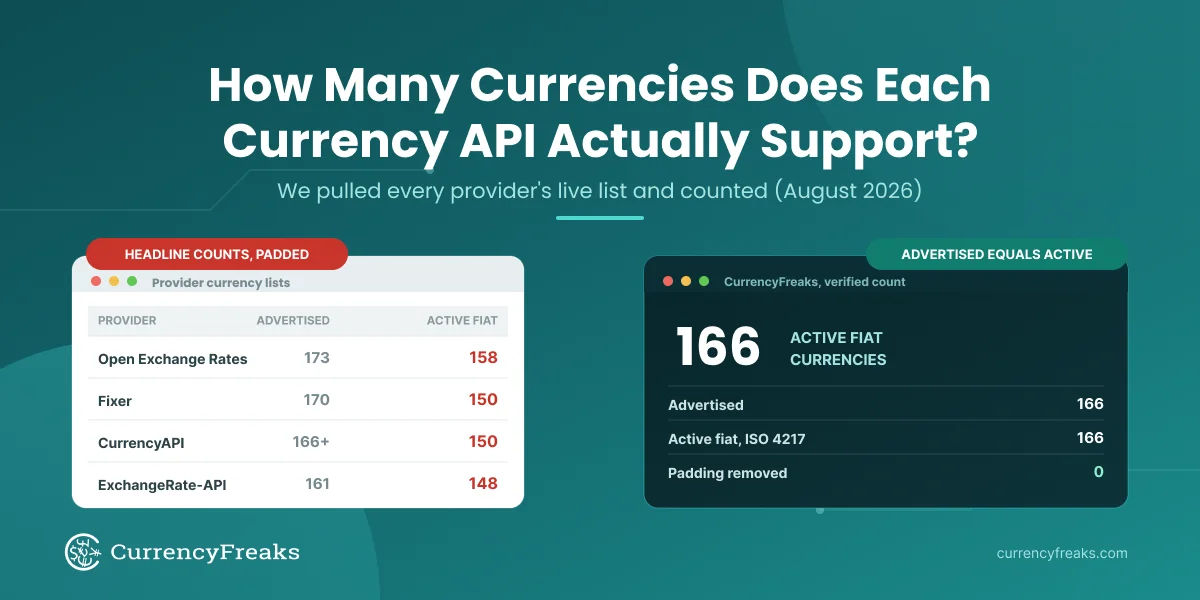
When you compare currency APIs, the supported currency count is one of the first numbers you check. Fixer says 170. Open Exchange Rates says 173. ExchangeRate-API says 161. CurrencyAPI advertises 166+.
Pick the one with the highest number and move on, right?
Not quite. After pulling the live currency list from every major provider and going through each code one by one, those headline numbers turn out to mean very different things. Some providers are counting currencies that were abolished over a decade ago. Others include codes for territories that use another country's currency entirely. A few are counting precious metals and crypto inside their "fiat" totals.
This post shows exactly what each provider includes, what gets stripped out when you count only active fiat currencies, and what the honest numbers look like side by side.
Why Currency Counts Differ
There are four things that inflate a provider's advertised currency count beyond what most applications would consider a "supported currency".
Unofficial Codes With No ISO 4217 Registration
ISO 4217 is the international standard for currency codes published by the International Organization for Standardization. If a code is not in ISO 4217, it is not a recognised currency in any formal sense. Several codes that appear on provider lists fall into this category.
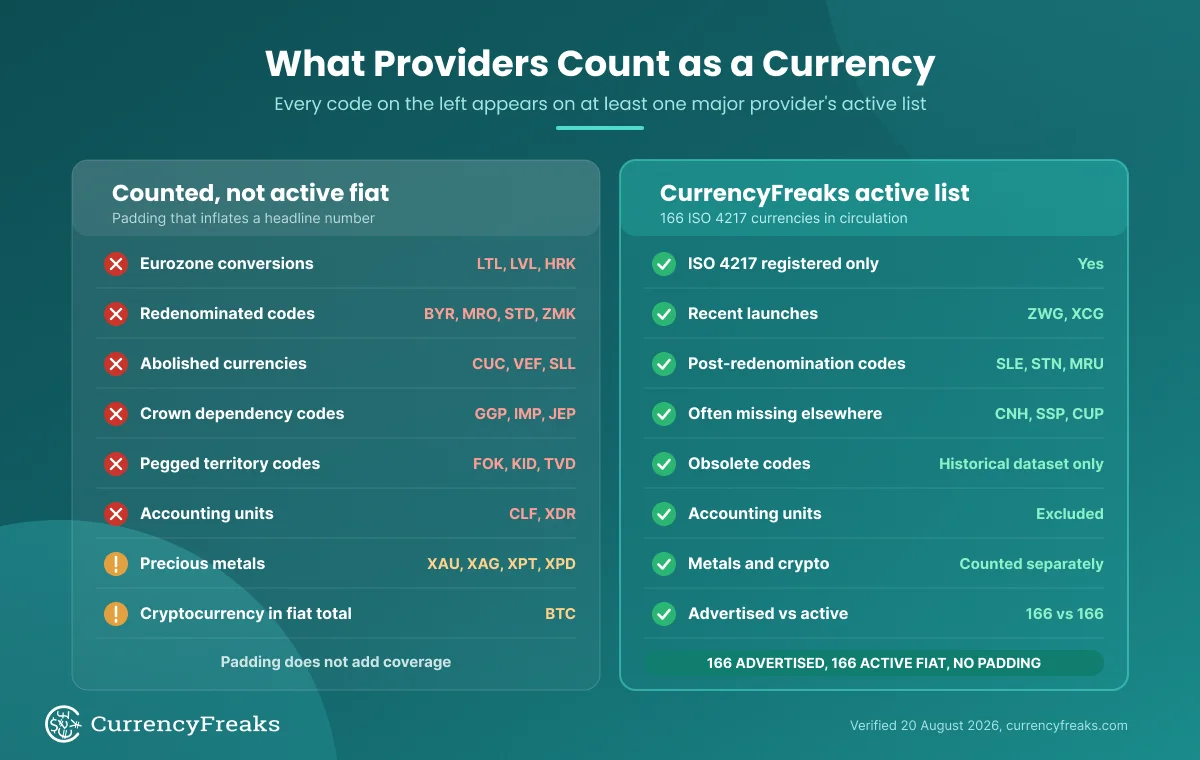
GGP, IMP, and JEP are the most common. These represent the Guernsey Pound, Isle of Man Pound, and Jersey Pound respectively. All three territories are British Crown dependencies whose residents use GBP for every transaction. The local banknotes look different from standard GBP notes but carry the same value and are legal tender in the UK. There is no separate exchange rate for GGP against GBP, because they are the same thing.
FOK (Faroese Króna), KID (Kiribati Dollar), and TVD (Tuvaluan Dollar) follow the same pattern: the Faroe Islands uses DKK, Kiribati uses AUD, and Tuvalu uses AUD. All six codes appear on at least one major provider's currency list.
Obsolete Currencies That No Longer Exist
Currency redenominations and eurozone conversions happen regularly. When a country replaces its currency, the old code becomes obsolete. Several providers keep these codes in their active lists long after the currencies ceased to exist:
-
LTL, Lithuanian Litas, replaced by EUR when Lithuania joined the eurozone in January 2015. Defunct for over eleven years.
-
LVL, Latvian Lats, replaced by EUR when Latvia joined the eurozone in January 2014. Defunct for over twelve years.
-
HRK, Croatian Kuna, replaced by EUR when Croatia joined the eurozone in January 2023. Defunct for three years.
-
BYR, Belarusian Ruble (old version), redenominated to BYN in July 2016. BYN is the current code.
-
MRO, Mauritanian Ouguiya (old version), replaced by MRU in January 2018. MRU is the current code.
-
STD, São Tomé and Príncipe Dobra (old version), replaced by STN in July 2018. STN is the current code.
-
ZMK, Zambian Kwacha (old version), replaced by ZMW in January 2013. Defunct for over thirteen years.
Maintaining these for historical data access is legitimate and useful. If your application needs to query what the exchange rate was between USD and LTL in 2014, that data should be accessible. The question is whether these codes belong in an "active currencies" count, which they clearly do not.
Accounting Units and Reserve Assets
CLF is the Chilean Unit of Account (Unidad de Fomento, or UF). It is an inflation-indexed unit used in Chilean mortgage contracts and long-term leases. It is not a tradeable currency, nobody sends or receives CLF in a transaction, and no bank offers CLF accounts. XDR is the IMF Special Drawing Rights, a reserve basket used only between central banks and the International Monetary Fund for accounting purposes. Neither belongs in a practical currency count for developer applications.
Crypto and Precious Metals Folded Into the Fiat Count
Some providers include BTC (Bitcoin), XAG (Silver), XAU (Gold), XPD (Palladium), and XPT (Platinum) in their currency totals. These are separate asset classes with distinct pricing mechanisms. A developer building a multi-currency checkout for an e-commerce store does not need gold pricing alongside EUR/USD rates. Counting them together inflates the number without adding relevant coverage.
The Verified Active Fiat Counts
Every currency list below was pulled directly from each provider's live endpoint or public currencies page on 20 August 2026. The active count removes all four categories above: unofficial non-ISO codes, obsolete or redenominated currencies, accounting units, and crypto or metals.
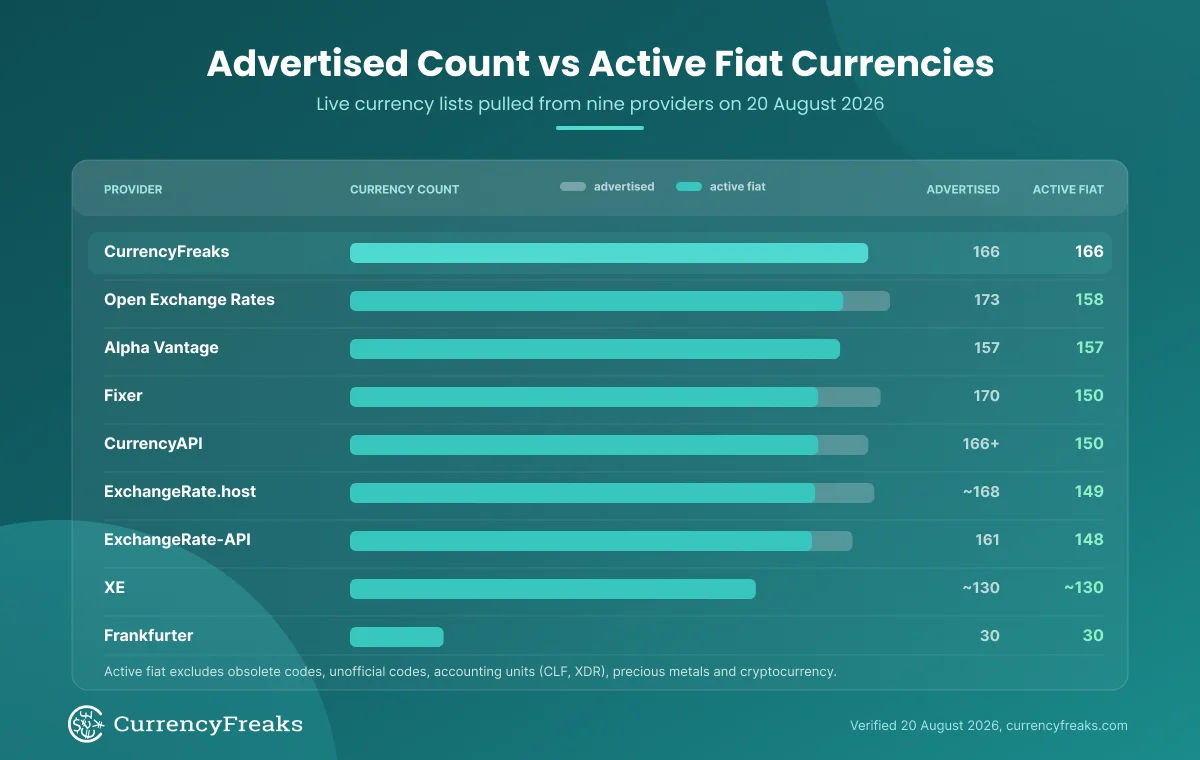
| Provider | Advertised | Active Fiat | Inflation Sources |
|---|---|---|---|
| CurrencyFreaks | 166 | 166 | None, matches exactly |
| Open Exchange Rates | 173 | 158 | BTC, 4 metals, XDR, GGP, IMP, JEP, CLF, STD, CUC, HRK, SLL |
| Alpha Vantage | 157 | 157 | None, honest count |
| Fixer | 170 | 150 | BTC, XAG, XAU, GGP, IMP, JEP, CLF, LTL, LVL, BYR, MRO, STD, ZMK, HRK and more |
| CurrencyAPI | 166+ | 150 | GGP, IMP, JEP, CLF, HRK, SLL |
| ExchangeRate.host | ~168 | 149 | BTC, XAG, XAU, XDR, GGP, IMP, JEP, CLF, LTL, LVL, BYR, MRO, ZMK, HRK and more |
| ExchangeRate-API | 161 | 148 | GGP, IMP, JEP, FOK, KID, TVD, CLF, HRK |
| XE | ~130 | ~130 | Honest count (no public currency list available) |
| Frankfurter | 30 | 30 | None, honest count |
Provider-by-Provider Breakdown
CurrencyFreaks: 166 Advertised, 166 Active
CurrencyFreaks is the only provider in this comparison where the advertised fiat count matches the active count exactly. The 166 figure represents every ISO 4217 fiat currency in active circulation as of August 2026. Deprecated and redenominated currencies, including LTL, LVL, HRK, BYR, MRO, STD, and ZMK, are maintained in a separate historical dataset and remain queryable for past rates, but they are not included in the active count. The total 1000+ figure that appears elsewhere in CurrencyFreaks' documentation refers to all currencies combined: 166 active fiat, 875 cryptocurrencies, and 4 precious metals.
CurrencyFreaks also carries several recently introduced currencies that some competitors have not yet added: ZWG (Zimbabwe Gold, launched April 2024), XCG (Caribbean Guilder, launched January 2025 for Curaçao and Sint Maarten), SLE (new Sierra Leone Leone after the 2022 redenomination), STN (new São Tomé Dobra after the 2018 redenomination), MRU (new Mauritanian Ouguiya after the 2018 redenomination), and VES (Venezuelan Bolívar Soberano). Keeping pace with redenominations is the most operationally intensive part of maintaining a currency API, and it shows most clearly in the gap between providers' active counts.
Open Exchange Rates: 173 Advertised, 158 Active
Open Exchange Rates publishes a public currencies endpoint (openexchangerates.org/api/currencies.json) that requires no API key. Pulling this list returns 173 entries. Subtracting what is not an active fiat currency:
-
BTC (Bitcoin), 1 crypto
-
XAG, XAU, XPD, XPT (Silver, Gold, Palladium, Platinum), 4 metals
-
XDR (IMF Special Drawing Rights), 1 accounting unit
-
GGP, IMP, JEP (Crown dependency "currencies"), 3 unofficial codes
-
CLF (Chilean Unit of Account), 1 accounting unit
-
STD (old São Tomé Dobra, replaced by STN in 2018), 1 obsolete
-
CUC (Cuban Convertible Peso, officially abolished January 2021), 1 obsolete
-
HRK (Croatian Kuna, replaced by EUR in January 2023), 1 obsolete
-
SLL (old Sierra Leone Leone, replaced by SLE after the 2022 redenomination), 1 obsolete
That removes 15 codes, leaving 158 active fiat currencies. Open Exchange Rates has the second-largest genuine coverage in this comparison, behind only CurrencyFreaks. Their list includes XCG (Caribbean Guilder, launched 2025) and ZWG (Zimbabwe Gold, launched 2024), which shows good coverage of recently introduced currencies.
Alpha Vantage: 157 Advertised, 157 Active
Alpha Vantage publishes a physical currency list at their documentation site. The count from that list is 157, and after checking, nothing needs to be removed. Alpha Vantage's fiat count is honest. They do not include unofficial codes, obsolete currencies, or accounting units in their physical currency list.
The gap between Alpha Vantage's 157 and CurrencyFreaks' 166 comes down to nine specific currencies. These are not niche or obscure, and several are large developing markets. The missing currencies from Alpha Vantage's list are CNH (Chinese Yuan offshore), CUP (Cuban Peso), SSP (South Sudanese Pound), SLE (new Sierra Leone Leone), STN (new São Tomé Dobra), MRU (new Mauritanian Ouguiya), VES (Venezuelan Bolívar Soberano), ZWG (Zimbabwe Gold), and XCG (Caribbean Guilder). If your application handles any of these, Alpha Vantage is not the right choice.
Fixer: 170 Advertised, 150 Active
Fixer publishes their full currency list at fixer.io/symbols. The page states "170 world currencies, including precious metals and Bitcoin." Working through the list:
-
BTC (Bitcoin), 1 crypto
-
XAG, XAU (Silver, Gold), 2 metals
-
GGP, IMP, JEP (Crown dependency codes), 3 unofficial
-
CLF (Chilean Unit of Account), 1 accounting unit
-
LTL (Lithuanian Litas, EUR since 2015), 1 obsolete
-
LVL (Latvian Lats, EUR since 2014), 1 obsolete
-
BYR (old Belarusian Ruble, replaced by BYN in 2016), 1 obsolete
-
MRO (old Mauritanian Ouguiya, replaced by MRU in 2018), 1 obsolete
-
STD (old São Tomé Dobra, replaced by STN in 2018), 1 obsolete
-
ZMK (old Zambian Kwacha, replaced by ZMW in 2013), 1 obsolete
-
HRK (Croatian Kuna, EUR since 2023), 1 obsolete
-
VEF (old Venezuelan Bolívar Fuerte, replaced by VES in 2018), 1 obsolete
-
SLL (old Sierra Leone Leone, replaced by SLE in 2022), 1 obsolete
-
CUC (Cuban Convertible Peso, abolished January 2021), 1 obsolete
That removes 20 codes, leaving 150 active fiat currencies. Fixer's genuine coverage is competitive, but the gap between their headline number (170) and the real figure (150) is the largest of any provider, at 20 codes of difference. The obsolete currencies they carry include some that have been defunct for over a decade.
Fixer is owned by APILayer. Their dataset and ExchangeRate.host's dataset share the same infrastructure, which is why both carry the same pattern of obsolete codes. For a full feature and pricing comparison, see our Fixer API pricing and alternative breakdown, or jump straight to the Fixer to CurrencyFreaks migration guide if you have already decided to move.
CurrencyAPI: 166+ Advertised, 150 Active
CurrencyAPI does not publish a simple public currency list without an API key. Their documentation page does list currencies alphabetically with their type (fiat, crypto, metal). Working through the visible fiat entries and cross-referencing against their claimed 166+ total, the active fiat count after removing:
-
GGP, IMP, JEP (Crown dependency codes), 3 unofficial
-
CLF (Chilean Unit of Account), 1 accounting unit
-
HRK (Croatian Kuna, EUR since 2023), 1 obsolete
-
SLL (old Sierra Leone Leone, replaced by SLE in 2022), 1 obsolete
-
CUC (Cuban Convertible Peso, abolished 2021), 1 obsolete
That gives 150 active fiat currencies. CurrencyAPI's overall product is solid, since they cover both fiat and crypto in a single API and their documentation is thorough. The gap between their claimed figure and the active count is relatively small and comes primarily from the Crown dependency codes and a few recently obsoleted currencies they have not cleared from their active list.
ExchangeRate.host: ~168 Advertised, 149 Active
ExchangeRate.host publishes a full currency list at exchangerate.host/currencies. Their page states "168 world currencies and precious metals." Removing the non-active entries:
-
BTC (Bitcoin), 1 crypto
-
XAG, XAU (Silver, Gold), 2 metals
-
XDR (IMF Special Drawing Rights), 1 accounting unit
-
GGP, IMP, JEP (Crown dependency codes), 3 unofficial
-
CLF (Chilean Unit of Account), 1 accounting unit
-
LTL (Lithuanian Litas, EUR since 2015), 1 obsolete
-
LVL (Latvian Lats, EUR since 2014), 1 obsolete
-
BYR (old Belarusian Ruble, replaced by BYN in 2016), 1 obsolete
-
MRO (old Mauritanian Ouguiya, replaced by MRU in 2018), 1 obsolete
-
STD (old São Tomé Dobra, replaced by STN in 2018), 1 obsolete
-
ZMK (old Zambian Kwacha, replaced by ZMW in 2013), 1 obsolete
-
HRK (Croatian Kuna, EUR since 2023), 1 obsolete
-
VEF (old Venezuelan Bolívar Fuerte, replaced by VES in 2018), 1 obsolete
-
SLL (old Sierra Leone Leone, replaced by SLE in 2022), 1 obsolete
-
CUC (Cuban Convertible Peso, abolished 2021), 1 obsolete
That removes 19 codes, leaving 149 active fiat currencies. ExchangeRate.host shares APILayer infrastructure with Fixer, which explains the near-identical pattern of obsolete codes in their active list.
ExchangeRate-API: 161 Advertised, 148 Active
ExchangeRate-API publishes their full currency list at exchangerate-api.com/docs/supported-currencies. Their documentation is notably transparent: the page explicitly warns developers that "ISO 4217 codes can be deprecated and replaced over time" and advises checking before use. Removing the non-active entries:
-
GGP, IMP, JEP (Crown dependency codes), 3 unofficial
-
FOK (Faroese Króna, since the Faroe Islands uses DKK), 1 unofficial
-
KID (Kiribati Dollar, since Kiribati uses AUD), 1 unofficial
-
TVD (Tuvaluan Dollar, since Tuvalu uses AUD), 1 unofficial
-
CLF (Chilean Unit of Account), 1 accounting unit
-
HRK (Croatian Kuna, EUR since 2023), 1 obsolete
That removes 13 codes, leaving 148 active fiat currencies. ExchangeRate-API is the provider that carries the most unofficial non-ISO codes, with FOK, KID, and TVD in addition to the common GGP, IMP, and JEP trio, but they carry fewer obsolete currencies than Fixer or ExchangeRate.host. Their documentation quality is high and their transparency about currency code deprecation is the best in this comparison.
Frankfurter: 30 Advertised, 30 Active
Frankfurter's live API endpoint api.frankfurter.dev/v1/currencies returns exactly 30 currencies as of August 2026. Every one of them is an active ISO 4217 fiat currency covered by the European Central Bank. No inflation, no unofficial codes, no obsolete entries. Frankfurter's currency count is the most conservative in this comparison, and also the most precisely accurate relative to its stated scope of ECB reference rates only.
The 30 currencies are exclusively major fiat pairs. If your application needs rates for PKR, NGN, UGX, BDT, MMK, or any currency outside the ECB's reporting scope, Frankfurter cannot help you.
XE: ~130 Active (Estimated)
XE does not publish a public currency list without authentication. Based on their documentation and their existing CurrencyFreaks comparison page, XE covers approximately 130 currencies, all fiat, with no crypto or metals in their standard API product. XE is a premium enterprise provider, and pricing starts at contact-only rates well above the other providers in this comparison. Their currency coverage is solid for major and secondary pairs but narrower than CurrencyFreaks, Open Exchange Rates, or Fixer.
What the Numbers Mean for Your Application
If you need rates for any of the following currencies, check your provider's active list before committing.
Recently introduced (2023 to 2025): XCG (Caribbean Guilder, January 2025), ZWG (Zimbabwe Gold, April 2024).
Post-redenomination codes many providers have not updated: SLE (Sierra Leone, 2022), STN (São Tomé, 2018), MRU (Mauritania, 2018), VES (Venezuela, 2018), BYN (Belarus, 2016).
Currencies some providers still list incorrectly: SSP (South Sudanese Pound, which several providers omit), CUP (Cuban Peso, sometimes missing or confused with the abolished CUC), and CNH (Chinese Yuan offshore, distinct from CNY and often missing).
If your application handles currencies from smaller or recently changed economies, run a quick test against your provider's API before launching. A provider claiming 170 currencies may not have the three you actually need.
For a wider feature comparison across the same providers, see 10 Best Currency Exchange API Options for Developers in 2026.
FAQs
Why Do Currency API Providers Show Different Currency Counts?
Providers use different methodologies. Some include obsolete currencies (for historical data continuity), unofficial non-ISO codes, accounting units like CLF, or precious metals and crypto in their fiat totals. The result is that "170 currencies" from one provider and "166 currencies" from another can mean very different things in practice.
Which Currency API Has the Most Accurate Fiat Coverage?
Based on the August 2026 analysis in this post, CurrencyFreaks has 166 active ISO 4217 fiat currencies, the highest accurate active count. Open Exchange Rates has the second-highest at 158 active fiat currencies. Both maintain deprecated currencies separately for historical queries.
Does Fixer Really Support 170 Currencies?
Fixer's active list includes currencies that were abolished between 2013 and 2023, unofficial codes for territories that use GBP and DKK, Bitcoin, precious metals, and an accounting unit (CLF). Removing these leaves 150 currencies in active circulation. The 170 figure is technically present in their dataset but misleading as a practical capability metric.
What Is the Difference Between CLF and a Real Currency?
CLF is the Chilean Unidad de Fomento, an inflation index used in real estate and long-term financial contracts in Chile. Its value updates daily based on the Chilean consumer price index. It cannot be used in transactions, held in a bank account, or exchanged at a bureau de change. It is a pricing reference unit, not a currency. Including it in a currency API count is technically arguable but practically misleading for most developers.
What Happened to the Croatian Kuna (HRK)?
Croatia joined the eurozone on 1 January 2023 and replaced the Croatian Kuna with the Euro at a fixed rate of 7.53450 HRK per EUR. HRK ceased to exist as an active currency from that date. Some providers still include HRK in their active lists. If you need historical rates involving HRK from before January 2023, that data is still valid and should be available through any provider with historical coverage.
Should I Add Currency Codes Like GGP, IMP, or JEP to My Application?
No. These codes have no ISO 4217 status and cannot be used in standard financial systems. If your application handles payments or currency conversion for users in Guernsey, Jersey, or the Isle of Man, use GBP, which is their actual currency. The local banknotes are denominated in pounds at parity with sterling.
All currency lists were pulled directly from each provider's live public endpoint or documentation page on 20 August 2026. Counts may change as providers update their currency coverage.