
Introduction
Finding a reliable currency exchange API in 2026 is harder than it sounds. There are now over a dozen providers offering free plans, and the differences between them, such as update frequency, base currency restrictions, HTTPS availability, and historical data access, are buried in documentation pages that most developers do not read before signing up.
This guide compares the 10 best currency exchange APIs available right now. For each one, we cover what the free plan actually includes (not the headline number, but the real constraints), when to use it, and when to switch. CurrencyFreaks is our top pick for production apps and SaaS products: 1,000+ currencies including crypto and precious metals, 1,000 free calls per month, rates every 60 seconds on the Professional plan, and historical data back to 1984 from the $9.99 Starter plan. Here is how the rest stack up, with a one-line "Best for" verdict on each.
What Is A Currency Conversion API?
A Currency Conversion API is a tool that returns the current or historical currency rate data via a program. Think of it like the exchange rate board at a bank's currency counter, except your app can read it instantly instead of a clerk checking it by hand. You ask the API for a rate. The service then returns the required currency rate in a standard format, such as a portable JSON format for easy integration or XML.
Why We Need Currency Conversion APIs
These APIs are necessary because they enable local pricing. They instantly change the price from your main currency to a user's local currency, making it easy to convert one currency to another for localized pricing. This clear change greatly improves the user experience and reduces shopping cart abandonment.
How A Currency API Works
The process is easy. Your app initiates an HTTP request to a specific API endpoint. This request must include a special API key to verify your authorization to use it. You also specify a base currency (e.g., USD) and the currencies you want rates for (e.g., EUR, GBP) in the request.
Your request goes to the API server. The server checks its huge database. This database is continually updated from many trusted sources, including national banks. The server then converts the requested rate data into a JSON or XML response. It sends this data back to your app. Your app quickly processes this data and applies the correct rates to your software.
Types Of Currency Conversion API Endpoints
A strong currency API provides several endpoints for specific use cases.
-
The Latest Rates endpoint is the most used; it provides the most current exchange rates in real time.
-
To make charts or do accounting, you use the Historical Rates location. This gives you rates for any past date you provide.
-
Developers use the Time Series endpoints to study trends. It provides time series data, offering a series of daily rates between two dates for analyzing historical exchange rate trends.
-
Finally, the Conversion endpoint makes things easier by doing the math. You can use it to convert currencies programmatically: enter the starting currency, the ending currency, and the amount, and it gives you the converted amount.
What Are The Features Of The Best Free Currency Conversion APIs?
You should look at the technical details of the free API plan when comparing them. These details show how useful and reliable a service is for professional work. The best APIs offer guaranteed availability and support scalable volumes for growing applications. A free service with no hidden fees is especially attractive, while premium features may be available at higher tiers.
Reliability And Data Quality
The exchange rates you receive must be accurate. Because of this, you should always choose APIs that get their data from official, trusted foreign exchange markets (forex) and national banks. The best APIs aggregate data from multiple central banks for enhanced accuracy. A high-quality API ensures that data remains safe as it moves by using SSL encryption, such as bank-grade 256-bit SSL encryption, to protect all data transfers from intrusions and hacking attempts. This is a very important feature of free services.
Coverage And Update Frequency
The best services include real-time data for hundreds of worldwide currencies. This covers standard cash currencies (fiat), precious metals, and, increasingly, many cryptocurrencies. Another key difference is how often the data updates. Free plans usually update daily.
Documentation And Ease Of Use
Clear, good documentation is a must for quick setup. Look for APIs with a simple endpoint structure and full details on each endpoint, along with clear and detailed code examples in multiple languages (e.g., Python, JavaScript, and PHP). This greatly reduces your development time and makes integration easier for developers at all experience levels. Also, an API that gives information in a simple, clean structure will always be the easiest for your apps to use.
JSON Response and Data Parsing
The CurrencyFreaks Exchange Rates API returns a flat JSON object: a date, a base currency and a rates map keyed by currency code. Whether you're building a currency converter for an e-commerce store, a financial dashboard, or a mobile app, reading a rate is one lookup, such as rates["EUR"]. Every endpoint also returns XML if you pass format=xml.
10 Best Free Currency Conversion APIs For Developers
It is important to pick the right tool. The list below shows 10 high-quality free currency APIs that will meet the needs of modern developers.
How We Ranked These APIs
Being transparent about method matters on a list published by one of the vendors on it, so here is how this one was put together. Every provider was assessed on six things: what the free tier actually allows (call volume, base currency, commercial use, historical access), how often rates refresh at each tier, how many genuinely active ISO 4217 currencies are covered rather than the advertised headline figure, whether crypto and precious metals are included and how far history goes back, which endpoints exist beyond latest-rates, and the published entry price for a paid plan. Figures were taken from each provider's own pricing page, terms, currency list or documentation and last verified on 15 October 2026. We re-check them on the first of every month.
CurrencyFreaks publishes this comparison, so treat the ranking as what it is: our own assessment against those criteria, with the underlying numbers stated so you can check them. Where a competitor is genuinely stronger on a criterion, that is called out in its section. Frankfurter needs no API key and CurrencyFreaks does. ExchangeRate-API allows 1,500 free calls a month against our 1,000. Open Exchange Rates and Fixer refresh hourly on their free tiers where ours refreshes daily, and Open Exchange Rates' OHLC endpoint (VIP plan) has no CurrencyFreaks equivalent. Frankfurter and ExchangeRate-API state plainly that their free plans allow commercial use. Alpha Vantage covers stocks and commodities alongside currencies. If one of those is the deciding factor for your project, the honest answer is that another API on this list fits better than ours.
Currency Exchange API Comparison: Free Plans At A Glance
Every figure below was checked on 15 October 2026 against the provider's own pricing page, terms or documentation. All ten serve HTTPS on their free plan or trial.
| API | Best for | Free calls/month | Commercial use on free plan | Base currency (free) | Historical on free | History starts | Crypto | Metals | Free plan updates | Paid from |
|---|---|---|---|---|---|---|---|---|---|---|
| CurrencyFreaks | Production apps, SaaS, crypto + fiat | 1,000 | No plan-specific limit* | USD | No (Starter $9.99) | 28 Nov 1984 | Yes | Yes | Daily (60 sec on Professional) | $9.99 |
| Fixer | Non-commercial EUR projects | 100 | No | EUR | Yes | 1 Jan 1999 | BTC only | Gold, silver | Hourly | $14.99 |
| ExchangeRate-API | E-commerce, fiat-only apps | 1,500 | Yes | Any | No (Pro $10) | 1990 (35 codes) | No | No | Daily | $10 |
| Open Exchange Rates | Hobby and open-source projects | 1,000 | No (personal, small-scale, open source) | USD | Yes | 1999 | BTC (more via a flag) | Yes | Hourly | $12 |
| CurrencyLayer | Non-commercial USD projects | 100 | No | USD | Yes | 1999 | BTC only | Gold, silver | Daily | $14.99 |
| XE Currency Data API | Large companies and ERP | No free plan (7-day trial) | n/a | n/a | n/a | 16 Nov 1995 | Yes (23) | Yes | n/a | $799/year |
| CurrencyAPI | Small commercial crypto + fiat apps | 300 | No | Not stated | Yes | 1999 | Yes (16) | Yes (4) | Daily | $9.99 |
| Frankfurter | Free fiat rates with no API key | No published cap | Yes | Any | Yes | 1948 | No | Yes (4) | Daily | No paid plan |
| Alpha Vantage | FX next to stocks and crypto research | 25/day | No | Any pair | Yes (daily series) | Not stated | Yes | Gold, silver | Not stated | $49.99 |
| ExchangeRate.host | Non-commercial projects needing XML or CSV | 100 | No | USD | Yes | 19 years (no date given) | Yes | Yes | Daily | $14.99 |
* The CurrencyFreaks terms of service apply the same license to every plan, with no separate free-plan clause. They allow you to display rates to the end users of your app and do not allow resale or redistribution of the data.
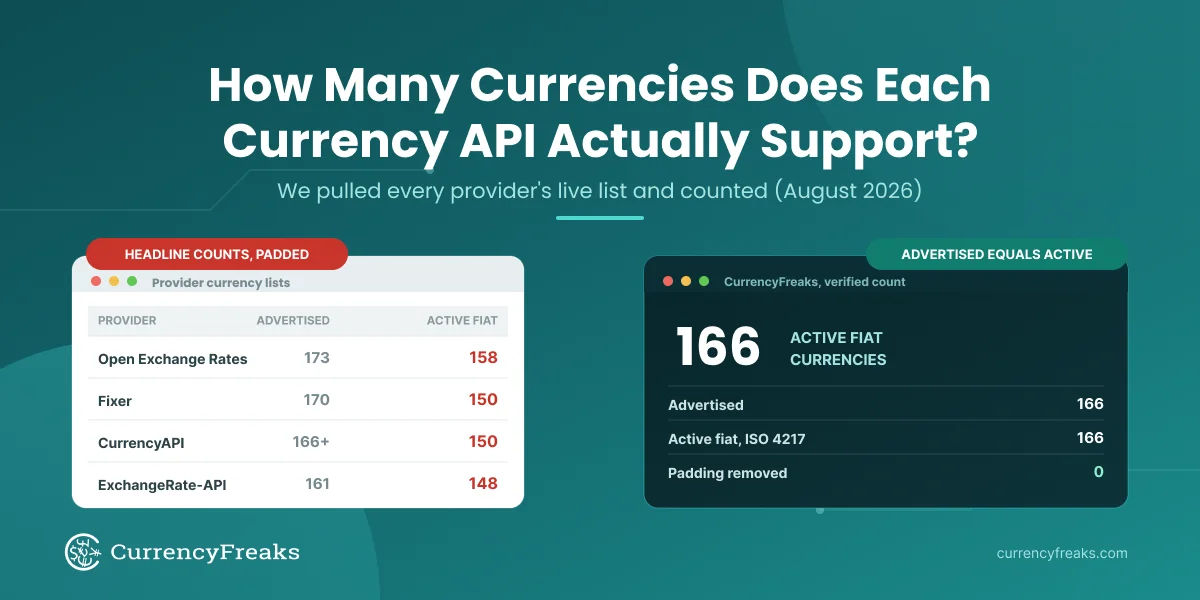
Currency counts in particular are worth a closer look. Most providers advertise a headline figure that includes obsolete currencies (some abolished over a decade ago), unofficial codes for territories that use another country's money, and accounting units that cannot be traded. For a provider-by-provider breakdown of what each advertised number actually includes, see How Many Currencies Does Each Currency API Actually Support?.
CurrencyFreaks -- The Best Currency Exchange API
Best for: production apps and SaaS products that need fiat, crypto and precious metals from one API. Rates refresh every 60 seconds on the Professional plan ($99.99/month) and every 10 minutes on Growth ($49.99/month), and daily history goes back to 28 November 1984 from the $9.99 Starter plan.
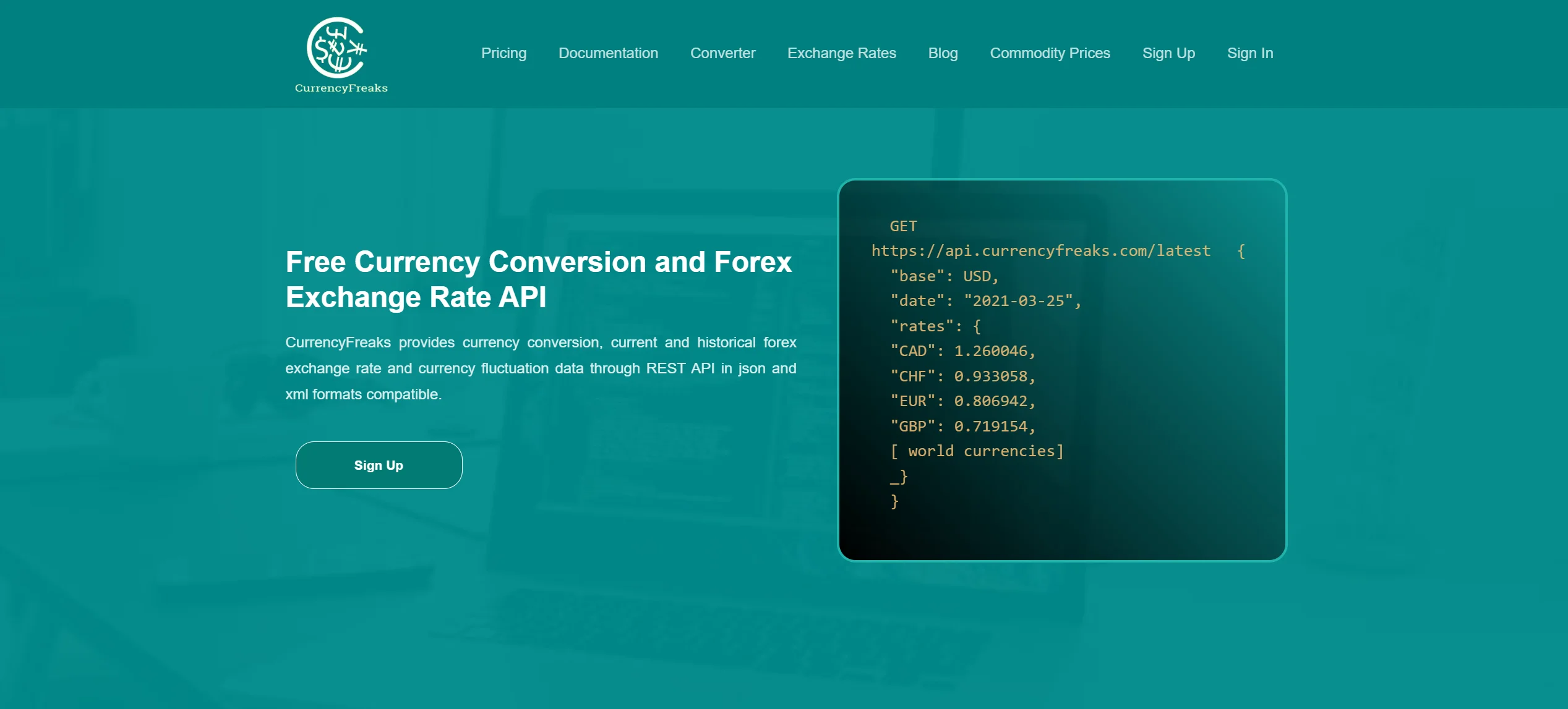
CurrencyFreaks is a website that offers live and historical exchange rate information. It covers 1,000+ currencies. This includes 166 cash currencies (fiats), 4 metals, and 874 cryptocurrencies. You get correct, fast, and trusted information on reliable financial products with instant access to exchange rate data.
The Starter plan lists its request cap, update frequency, and feature set upfront on the pricing page, so you know what $9.99/month buys before you sign up.
Features
-
Currency coverage: 1,000+ currencies: fiat, crypto and precious metals. Updates every 60 seconds on the Professional plan, every 10 minutes on Growth.
-
Accurate information: Obtained through certified financial institutions to get reliable data.
-
High security: All requests use HTTPS.
-
High speed: Geo-based routing keeps latency at 20-40 ms worldwide.
-
Proper documentation: Step-by-step instructions for easy setup.
-
Priority support: Paying customers receive fast email response.
# Get live rates (free plan)
curl "https://api.currencyfreaks.com/v2.0/rates/latest?apikey=YOUR_API_KEY&symbols=EUR,GBP,JPY"
{
  "date": "2026-08-12 00:00:00+00",
  "base": "USD",
  "rates": {
    "EUR": "0.921400",
    "GBP": "0.781300",
    "JPY": "147.820000"
  }
}
The same endpoint structure works for historical rates (
/v2.0/rates/historical?date=YYYY-MM-DD) and time series (/v2.0/timeseries?start_date=...&end_date=...).
Pricing
Free with the option of upgrading. Get a discount with yearly billing.
-
Developer (Free): 1,000 requests/month, 24-hour updates, USD base, SSL, no credit card.
-
Starter ($9.99/month): 15,000 requests per month, hourly updates, live and historical rates (back to 28 November 1984 for major fiat currencies), and all base currencies.
-
Growth ($49.99/month): 150,000 requests/month, 10-minute updates, IP-to-currency, premium support.
-
Professional ($99.99/month): 550,000 requests/month, 60-second updates, time series and fluctuation, premium support.
-
Enterprise (Custom): custom request volume, 60-second updates, and access to every endpoint.
Suitable For
CurrencyFreaks is for developers of SaaS, fintech, e-commerce and crypto apps who want one key for fiat, crypto and metals. Pick it over the APIs below when you need 60-second rates (Professional) or IP-to-currency (Growth) without paying for a separate crypto feed. Pick Frankfurter instead if you only need daily fiat rates and want no API key.
Fixer -- Another Free Currency Exchange Rate Data API
Best for: non-commercial projects that work in EUR and want free historical rates back to 1999 on hourly updates.
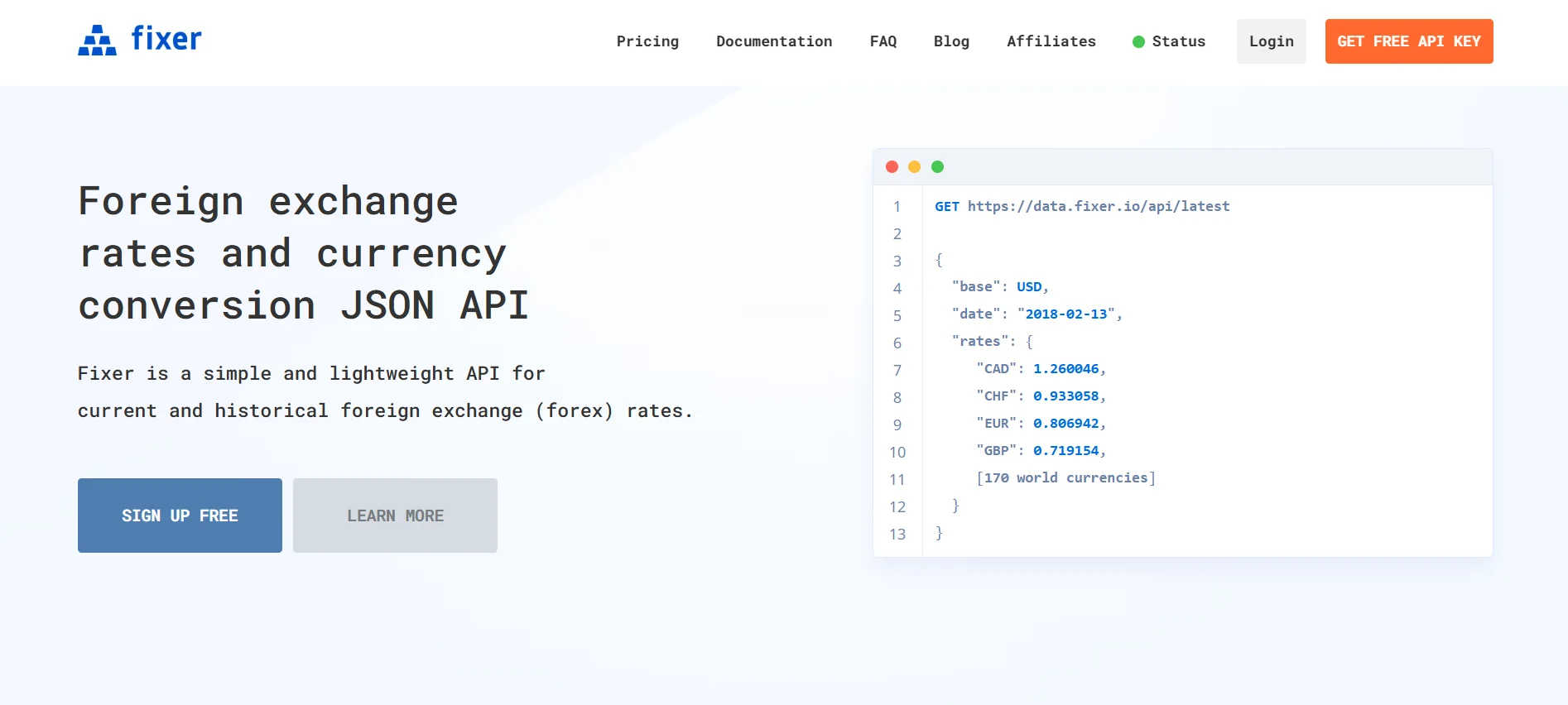
Fixer offers both live and historical foreign exchange rates via a simple and reliable JSON API. It handles 170 currencies, including Bitcoin, gold and silver, and updates as often as every 60 seconds on the Professional Plus plan. The information comes from trusted financial sources, for example, the European Central Bank. You can set it up in a few minutes and start getting reliable currency data right away.
The Professional plan costs $59.99/month ($52.99/month billed yearly) for 100,000 calls and 10-minute updates, with no separate charge for time series data.
Features
-
Live data of 170 global currencies.
-
Historical data back to 1 January 1999, on every plan.
-
Live conversion, time series, and fluctuation endpoint.
-
Bank level 256-bit secure linkage through the use of SSL.
-
Detailed documentation and a clean code sample.
-
Quick reaction time and performance up-scalability.
Pricing
-
Free: 100 API calls/month, hourly updates, EUR base currency only, non-commercial use only. HTTPS and historical data are included; all base currencies and commercial use require a paid plan.
-
Basic ($14.99/month, or $13.99/month billed yearly): 10,000 calls, all base currencies, regular support.
-
Professional ($59.99/month, or $52.99/month billed yearly): 100,000 calls, 10-minute updates, time series information.
-
Professional Plus ($99.99/month, or $84.99/month billed yearly): 500,000 calls, 60-second updates, full feature access.
-
Enterprise (Custom): Higher volumes or special needs.
Suitable For
-
Application developers
-
Mobile apps that require real-time currency data integration.
-
New businesses and companies that handle international transactions.
-
E-commerce and financial dashboards.
ExchangeRate-API -- A Top-Notch Free Currency Converter API
Best for: e-commerce stores and fiat-only apps that want the most free calls among keyed APIs (1,500/month), any base currency, and commercial use allowed on the free plan.
This API provides live, accurate currency exchange information and offers a reliable free service for developers. It is quick, direct, and easy to use. It can be set up in a few minutes using a few lines of code. It does not matter whether you create a dashboard, an application, or a shop. With this API, your data is always up to date and accurate.
Features
-
Get exchange rates for 165 currencies.
-
Get clean and easy-to-read JSON responses.
-
Get an hourly update on the paid and a daily update on the free tier.
-
Use more than one data confirmed source.
-
Be always online with AWS-guaranteed performance and uptime.
-
Get any needed documentation and support on demand.
Pricing
-
Free Plan ($0 per month): Get 1,500 requests. Data updates once a day. Its terms say the free plan is "suitable for either commercial or personal use".
-
Pro Plan ($10 per month): Get 30,000 requests. Data updates every hour. Includes historical data (from 1990 for 35 currencies, from 2021 for the rest) and email support.
-
Business Plan ($30 per month): Get 125,000 requests per month. Data updates every 5 minutes. High availability and priority support are included.
Select a plan that is right for you. You can upgrade anytime.
Limitations
-
No cryptocurrency or precious metal support at any tier.
-
Historical rates require the Pro plan; the free tier is latest-rates only.
-
Free tier updates once a day, so it is not suited to intraday movement.
-
Its 165 codes include unofficial territorial codes (GGP, IMP, JEP, FOK, KID, TVD) alongside active ISO 4217 fiat currencies. To their credit, their own documentation warns developers to check for deprecated codes, which is rarer than it should be.
Quick Example
curl "https://v6.exchangerate-api.com/v6/YOUR_API_KEY/latest/USD"
Suitable For
It is an API that anyone can use for fast, accurate currency information.
-
SaaS architecture with dynamic rates of exchange.
-
Powering local pricing of e-commerce stores.
-
Develop dashboards to monitor transactions worldwide.
-
FX data will be reliable to automate spreadsheets or research projects.
Open Exchange Rates -- Simple And Free Currency Converter API
Best for: personal and open-source projects that want hourly updates and history back to 1999 for free, and larger teams that need OHLC data (VIP plan).
The OER provides high-quality, up-to-date currency data. It has over 100,000 users and businesses. Live exchange rate and conversion information are provided in seconds. The API is made to be developer-friendly. Because of this, it is simple and clean with easy scalability to your app, and supports scalable volumes for growing applications.
Features
-
Live and historical rates (back to 1999) for 170+ currencies, Bitcoin and four precious metals.
-
Get information in simple, easy-to-read JSON form.
-
Combine with 200+ Open-source packages and libraries.
-
Get insights with time-series and conversion APIs.
-
OHLC endpoint (VIP plan): open, high, low and close values per period, which most competitors in this list do not offer at all. If you are charting rate movement rather than just converting, this is the differentiator.
-
Usage endpoint: your application can query its own remaining quota programmatically instead of checking a dashboard.
-
A public currencies list that needs no API key, which makes it easy to validate currency codes before you sign up.
-
Grow big projects into high-traffic apps.
Pricing
-
Free Plan ($0/month): 1,000 API requests a month with hourly updates, daily historical rates, and USD as the base currency. The hourly refresh on a free tier is more frequent than most providers in this list allow without payment. Its FAQ calls the free plan "forever free for personal, small-scale and open source use" and points commercial apps to a paid plan.
-
Developer Plan ($12/month): You receive updates every hour, 10,000 API requests a month, and all base currencies are available to you. Perfect use of new companies and small projects.
-
Enterprise Plan ($47/month): This includes 30-minute updates, 100,000 API requests per month, and time-series. Perfect for small or medium teams.
-
Unlimited Plan ($97/month): You receive 5-minute updates, unlimited API calls, and full currency conversion. Best suited to high-demand companies.
Limitations
-
The free plan is restricted to USD as the base currency, so cross-rates between two non-USD currencies must be calculated in your own code.
-
No cryptocurrency coverage beyond Bitcoin. Time series and 30-minute updates start at the $47/month Enterprise plan.
-
Of the 173 codes on its published list, 158 are active ISO 4217 fiat currencies. The rest are Bitcoin, four precious metals, the IMF's XDR, three Crown dependency codes, and a handful of retired currencies.
Suitable For
It works best with developers, startups, and business projects that rely on accurate, scaled currency information, and it is the strongest choice in this list for charting use cases thanks to the OHLC endpoint on its VIP plan.
CurrencyLayer -- A Strong, Free Currency Converter API
Best for: non-commercial projects that work in USD and need historical rates back to 1999 on the free plan.
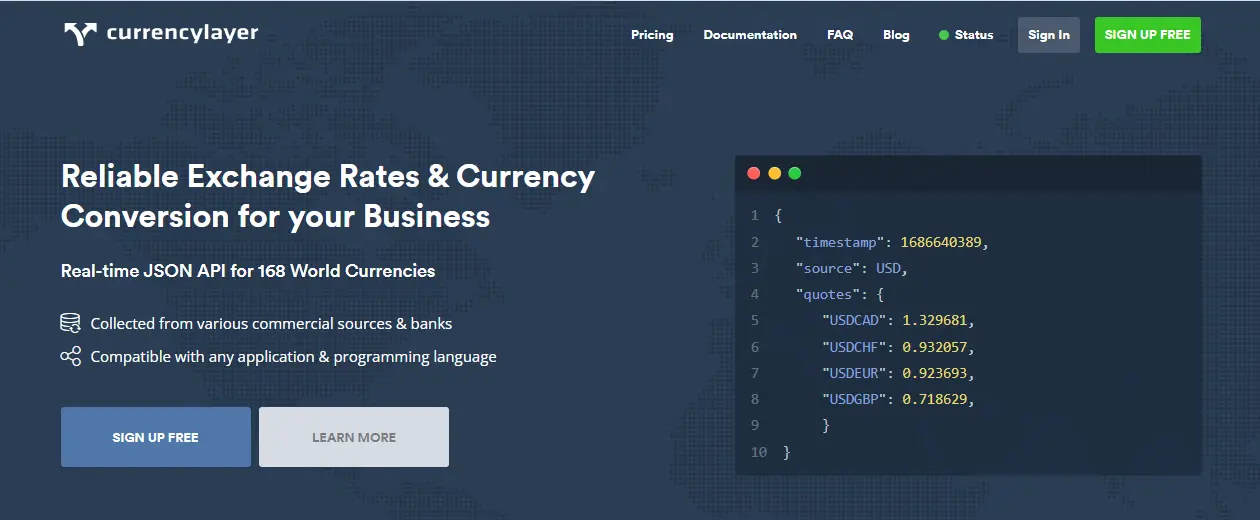
CurrencyLayer provides instant, competitive exchange rates by aggregating data from multiple commercial sources, including banks and financial institutions. It deals with 168 global currencies and precious metals. It is compatible with any application or program language within minutes. It has over 250,000 companies that rely on it for accurate data. This API is suitable if you need quick, reliable foreign exchange rates.
For enterprise users, CurrencyLayer offers priority support with dedicated account management.
Features
-
Correct Data: Receive live updates at least 60 minutes, 10 minutes, or even 60 seconds.
-
Wide Coverage: Access rates for 168 currencies and metals at all times.
-
Historical Data: daily rates back to 1999, included on the free plan.
-
Simple JSON endpoints: Simple to integrate with simple JSON endpoints.
-
Conversion Tools: Change base sources and currencies, and watch rate changes in real time.
-
Safe Web: Enjoy HTTPS with 256-bit encryption for secure data access.
-
Usage Insights: Visually monitor your API usage and receive notifications when you hit limits.
-
Developer Support: An interactive documentation and quick-to-respond technical support.
Pricing
-
Free Plan ($0/month): 100 API calls, daily updates, HTTPS, and historical rates. Non-commercial use only.
-
Basic ($14.99/month, or $13.99/month billed yearly): 10,000 requests/month, hourly updates, commercial usage, and basic support.
-
Enterprise ($59.99/month, or $52.99/month billed yearly): 100,000 requests/month, updates every 10 minutes, time-frame queries, and other advanced tools.
-
Enterprise+ ($99.99/month, or $84.99/month billed yearly): 500,000 requests/month, 60-second updates, full access, and platinum support.
Need more? Ask about a custom enterprise plan with unlimited calls and dedicated support.
Suitable For
CurrencyLayer is great for companies, small teams, and developers. Use it on currency converters, finance apps, or dashboards.
XE Currency Data API -- A Trusted Authority In Currency APIs
Best for: large companies and ERP teams that want a long-established brand and can pay from $799 a year.
Meet the XE Currency Data API. Its paid plans cover 170+ currencies and precious metals. With more than 30 years of foreign exchange experience, XE gets information directly from leading financial data providers, financial institutions, and central banks. It is dependable and of professional quality.
Features
-
Minutely rates as a paid add-on; daily, hourly or 15-minute rates by plan.
-
100+ trusted sources worldwide for access.
-
Look into historical rates, monthly means, and volatility trends.
-
170+ currencies and precious metals, plus 23 cryptocurrencies via
crypto=true. History back to 16 November 1995. -
Easy setups with SDKs of Java, NodeJS, PHP, and Python.
-
Quickly set it up with SAP, Oracle, or Microsoft Dynamics.
-
Below are user examples and documentation that are easy to follow.
Pricing
-
Lite: $799/year, 10,000 requests/month (daily rates).
-
Intermediate: $1,799/year, 50,000 requests/month (hourly and daily).
-
Prime: $4,499/year, 150,000 requests/month (15-min, hourly, and daily).
-
Enterprise: Individual pricing and full access to live rates and limits.
-
Live minutely rates ($400 to $1,500/year) and alternative source rates ($200 to $500/year) are paid add-ons.
-
No free plan. Try it first with a 7-day free trial.
Suitable For
-
Companies that need live FX information.
-
Managers creating applications or ERP systems.
-
Fintechs and financial institutions need accurate rates.
-
IT and software vendors building data-driven products.
-
Any person wanting fast, scalable, and reliable data on currency.
CurrencyAPI -- A Great Option For Fiat And Crypto
Best for: small commercial projects that need fiat, 16 cryptocurrencies and 4 precious metals from $9.99 a month.
Currencyapi provides current and past exchange rates for 171 fiat currencies, 16 cryptocurrencies and 4 precious metals, with daily history back to 1999. It is an automatic update. This means that the information will never be old. The API is quick, safe, and easy to set up. For business users, Currencyapi's paid tiers scale from $9.99 to $79.99 a month with a flat per-key price at each level, so cost stays predictable as usage grows.
Features
-
171 fiat currencies, 16 cryptocurrencies, gold, silver, platinum and palladium.
-
Live and historical rates.
-
REST API with JSON output.
-
Sandbox testing and HTTPS encryption.
-
SDKs and Postman collection.
-
60-second updates on the Medium and Large plans.
-
Multi-language support.
Pricing
-
Free ($0/month): 300 requests, 1 key, private use only (no commercial use), updated daily.
-
Small ($9.99/month): 15,000 requests, 1 key, commercial use, hourly updates.
-
Medium ($39.99/month): 600,000 requests, 2 keys, sandbox access, 60 sec updates.
-
Large ($79.99/month): 1.7M requests, 5 keys, access to sandbox, 60 sec updates.
-
Custom: Custom keys, flexible requests, as well as full commercial usage.
Suitable For
Great for developers, projects, and companies that need trustworthy foreign exchange or crypto data. Best in e-commerce, analytics, and finance dashboards.
Frankfurter -- The Best Free Currency API With No API Key Required
Best for: free prototypes and internal tools that need daily fiat rates with no API key, including commercial use.
Frankfurter is an open-source exchange rate API. Version 1 used only European Central Bank (ECB) data. The current v2 pulls daily rates from 104 central banks and official sources. It stands out for one reason above all others: it requires no API key, no signup, and no credit card. You send a request and get rates back immediately.
For developers who want to prototype quickly or build internal tools without account setup, Frankfurter is the cleanest starting point available in 2026.
Features
-
No API key required, so it works out of the box with zero setup
-
Daily rates from 104 central banks and official sources (v2)
-
165 currencies with current rates on the v2
/currenciesendpoint (checked 15 October 2026), against 30 on the ECB-only v1. Its site lists 223. -
Historical rates back to 1948 on v2
-
Endpoints: latest rates, historical rates, time series, currency conversion
-
Open source (MIT) and self-hostable
-
Commercial use allowed: its site says blended rates are "free to use"
-
HTTPS only
Limitations
-
No crypto. Gold, silver, platinum and palladium are on its currencies list
-
Daily update frequency, so it is not suitable for real-time trading applications
-
No official SLA or uptime guarantee (community-maintained)
-
No paid plan, so there is no path to upgrade for higher frequency or more currencies
-
v1 is deprecated, so older tutorials that call
/v1/latestneed updating
Quick Example
# No API key needed
curl "https://api.frankfurter.dev/v2/rates?base=USD"es=EUR,GBP,JPY"
[
  { "date": "2026-10-01", "base": "USD", "quote": "EUR", "rate": 0.88124 },
  { "date": "2026-10-01", "base": "USD", "quote": "GBP", "rate": 0.75368 },
  { "date": "2026-10-01", "base": "USD", "quote": "JPY", "rate": 157.41 }
]
Bottom line: Frankfurter is the best starting point for zero-friction prototyping. When your application needs crypto, intraday updates, or a guaranteed SLA, migrate to CurrencyFreaks. The free plan covers 1000+ currencies with 1,000 calls/month and takes under 5 minutes to set up.
Alpha Vantage -- Reliable Market Data For Traders
Best for: research and analysis that puts FX next to stocks, crypto and technical indicators. The free tier is 25 requests a day and non-commercial.
Alpha Vantage provides live and historical market data, along with technical indicators for financial analysis. It covers a variety of asset classes, including stocks, forex, cryptocurrencies, ETFs, and commodities. You receive enterprise-level financial data that is easy for traders, developers, and analysts.
Features
-
Live access to stock, forex, crypto, and commodity data.
-
Get more than 60 technical and economic indicators.
-
Built-in AI agent and spreadsheets support.
-
The financial news and market sentiment analysis in a single place.
-
Easily set up with Google Sheets, Excel, and cloud applications.
Pricing
-
Free: 25 requests per day, for "personal, non-commercial use" per its terms. Commercial users are asked to contact sales.
-
Premium ($49.99 to $249.99/month): 75 to 1,200 requests per minute with no daily cap. Intraday FX data (
FX_INTRADAY) is premium-only.
Suitable For
Best suited to developers, quant researchers, fintech startups, and traders who need to be able to rely on market data. It can also be helpful to students and teachers who study finance, AI, or data science.
ExchangeRate.host -- Fast And Generous Free Tier
Best for: non-commercial USD projects that want XML, CSV or TSV output. It is run by APILayer, the company behind Fixer and currencylayer, and shares currencylayer's price points.
ExchangeRate Host offers both historical and current forex and crypto data. It is quick, easy to get around, and useful. With more than 160 supported currencies and metals, you can use an easy JSON interface. ExchangeRate.host's free plan carries no signup fee or credit card requirement. This can be set up with your application in no time.
Features
-
Live rate and past historical data.
-
19 years of records.
-
168+ currencies and metals.
-
Endpoints Conversion and time series Endpoints.
-
99.99% uptime.
-
Trusted source of financial information.
-
JSON by default, with XML, CSV or TSV output on request.
-
Developer support and useful documentation.
Pricing
-
Free: $0/month. 100 API calls/month, daily updates, USD as the only source currency, non-commercial use only.
-
Basic: $161.99/year or $14.99/month. 10,000 requests/month, hourly updates.
-
Professional Plus: $629.99/year or $59.99/month. Up to 100,000 monthly requests, 10-minute updates.
-
Business: $1,019.99/year or $99.99/month. Up to 500,000 monthly requests, 60-second updates.
-
Optional Platinum Support for faster help.
Suitable For
Best when developers, startups, and businesses need correct and fast rate data. Perfect with financial dashboards, analytics applications, and currency-related apps.
Conclusion
Pick by the job your app has to do:
- Production apps and SaaS products, fiat plus crypto and metals: CurrencyFreaks. Rates refresh every 60 seconds on Professional ($99.99/month) and every 10 minutes on Growth ($49.99/month), with history back to 1984 from the $9.99 Starter plan.
- Free, no API key, commercial use allowed: Frankfurter.
- Most free calls on a keyed plan, commercial use allowed: ExchangeRate-API, 1,500 a month, fiat only.
- Hourly updates on a free personal or open-source project: Open Exchange Rates.
- Known brand for an ERP rollout: XE Currency Data API, from $799 a year.
Full plan details for CurrencyFreaks are on the pricing page, and every endpoint is in the documentation.
Whichever you start with, build your integration to cache responses and handle 429 errors gracefully. Nearly every free plan has a monthly or daily limit, and hitting it in production without a fallback is the most common mistake developers make with currency APIs.
Start with the CurrencyFreaks free plan: no credit card, API key in 30 seconds.
FAQs
Which Of These APIs Is Easiest To Migrate To From Fixer Or Currencylayer?
CurrencyFreaks, ExchangeRate.host, and CurrencyAPI are the closest structural matches. All three return JSON with a base currency and a rates object keyed by currency code, which is the same shape Fixer and Currencylayer return, so your parsing logic usually survives the move. In practice you change the endpoint URL, the API key parameter name, and any call that relies on an endpoint the new provider does not have. Two gotchas apply regardless of which you pick: rates come back as strings rather than numbers, and free tiers are usually USD-base only, so cross-rates between two non-USD currencies have to be calculated in your own code. If you have settled on CurrencyFreaks, the Fixer to CurrencyFreaks migration guide maps every endpoint with working code in Python, JavaScript, and PHP.
What Programming Languages Can I Use With A Currency API?
Almost any programming language can be used. They are REST APIs. This means all you need to do is make an HTTP request and handle the JSON data you receive. Examples include Python (requiring requests), JavaScript (requiring fetch), PHP, Java, and Ruby. PHP developers using Laravel can follow the Laravel currency API integration guide for a complete implementation with caching and Artisan commands.
Can I Get Both Real-Time And Historical Exchange Rates Using These APIs?
Yes, the premium APIs provide special endpoints for both needs. The most recent rates endpoint gives the most current data. The historical rates endpoint returns historical rates by accepting a required date parameter, usually in the format YYYY-MM-DD.
Do Free Currency APIs Also Support Cryptocurrency Exchange Rates?
Some do. CurrencyFreaks, CurrencyAPI, Alpha Vantage, ExchangeRate.host and XE include cryptocurrencies. Fixer, currencylayer and Open Exchange Rates carry Bitcoin only. ExchangeRate-API and Frankfurter carry none. Each provider's supported-currencies list shows the exact codes.
Which Of These APIs Refreshes Rates Most Often On A Free Plan?
Open Exchange Rates and Fixer, both hourly. Open Exchange Rates allows 1,000 free calls a month, Fixer 100, and both free plans are non-commercial. Most other free tiers in this list, including CurrencyFreaks, ExchangeRate-API, CurrencyAPI, and Frankfurter, refresh once a day. If you need sub-hourly movement you are into paid plans everywhere: CurrencyFreaks reaches 10 minutes on Growth ($49.99) and 60 seconds on Professional ($99.99).
Which Currency API Has The Most Generous Free Plan In 2026?
Among the ten ranked here, ExchangeRate-API offers the most free calls on a keyed plan: 1,500 per month, with commercial use allowed. Frankfurter has no published cap and needs no key. CurrencyFreaks offers 1,000 calls per month but covers 1,000+ currencies, including crypto and metals, versus ExchangeRate-API's 165 fiat currencies.
Can I Use A Currency API Without An API Key?
Yes. Frankfurter requires no API key, no signup, and no credit card. Its v2 API returned 165 currencies with current rates on 15 October 2026, updated daily from central bank data. For broader currency coverage including crypto, CurrencyFreaks requires a free signup but takes under 5 minutes and no payment details.
Register with CurrencyFreaks and get your free API key with 1,000 calls a month.