

Imagine a customer in London who is visiting your e-commerce store. They discover an ideal pair of shoes at $100. They assume it is about £78.
By the time you check out, your statistic rates have not been updated in weeks. Then, market dynamics suddenly change, and the price increases to £85. The customer is disappointed and leaves the cart.
This is the situation that occurs to millions of businesses in the world. The use of manual updates or the use of outdated foreign exchange rates results in lost revenue. Scaling international brands requires having access to correct exchange data.
This blog talks about why Currency API is no longer luxurious. It has become a product management feature requests priority. We are going to discuss the technical and strategic worth of real-time currency conversion.
What Is A Currency API And Why Does It Matter?
Currency API is a program interface. It offers real time exchange rates of various currencies. This enables systems to change values in real time and correctly.
Your system does not search bank websites but instead makes api requests to an authorized service. Response is in a structured format and can be processed easily. It is typically sent in the form of XML or JSON.
This data is used by businesses to automate payments and prices. It is also used to control the foreign exchange risks in the international markets. This enhances better financial control and accuracy.
To the developers, it is easy and quick to integrate. Real time data is linked to applications with the aid of a secure api key. This turns the fixed sites into moving global solutions.
Helpful Resource: Why Businesses Are Switching From the Google Currency Exchange Rate API to Better APIs
Key Categories Of Currency Data
| Category | Description | Common Use Case |
|---|---|---|
| Real-Time Rates | Rates updated every minute or hour. | Checkout pages and live trading. |
| Historical Rates | Data from specific past dates. | Accounting, audits, and trend analysis. |
| Currency Conversion | Direct calculation between two amounts. | Currency converter API tools for users. |
| Fluctuation Data | Percentage change over a period. | Product management strategy and risk assessment. |
How To Choose The Best Currency API For Your Business
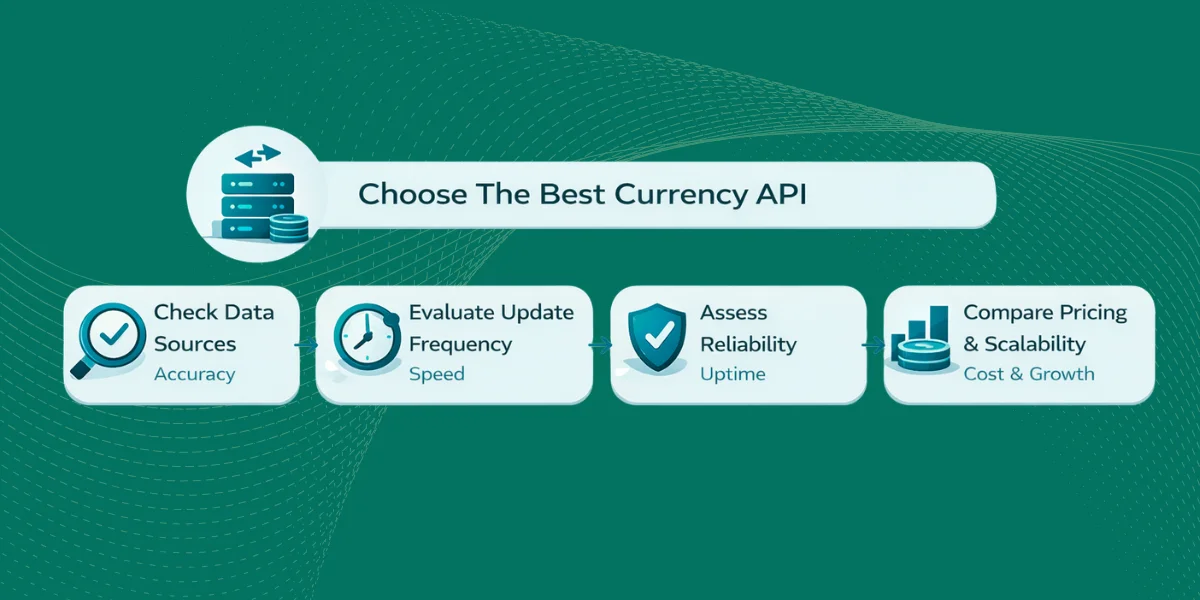
The selection of a suitable Currency API plays a significant role in the success in the long term. Not every single provider is equally accurate, fast, or even reliable. A weak solution may cause pricing mistakes and decrease customer confidence.
Check Data Sources And Accuracy
The first step is to monitor the data sources used by the provider. Identify credible institutions such as the European Central Bank or the financial authorities of nations. This ensures you transparency and consistency of your exchange rates.
Evaluate Update Frequency
Another important factor is the frequency of updates. There are APIs that are updated on a daily basis, and those that provide real time data every minute. Companies that involve high volumes of transactions should always want quicker updates.
Assess Reliability And Uptime
Reliability and uptime are also to be taken into account. Your system must operate effectively even in times of high sales or volatility in the market. Global infrastructure and high-uptime providers are more stable.
Review Developer Experience And Documentation
The experience of the developer is also important. Clear documentation, SDKs, and sample code are used to ensure minimal integration time. This helps to increase the efficiency and speed up product launching.
Compare Pricing And Scalability
Scalability and pricing transparency are important. Flexible plans help startups grow without switching providers. This supports long-term business expansion. Currency API is scalable and supports long-term global growth.
Helpful Resource: 10 Best Currency Exchange API Options for Developers
10 Reasons Your Business Needs A Real-Time Currency API
In the modern global digital economy, companies are active in numerous countries. They have to work with various currencies on a daily basis. The customers demand correct prices and quick dealings.
A currency API in real-time can fulfill such expectations. It offers efficient exchange rates in real-time. This enhances transparency and trust.
Real-time conversion is essential in e-commerce, in fintech, and any other application. It helps to automate and reduce financial risks. It also helps businesses to expand globally and stay competitive.
1. Eliminate Hidden Fees And Inaccuracies
The hidden fees professional level are commonly caused by manual entry. Any slight error in exchange rate data may lead to losses. Such mistakes decrease the profit on each sale.
A one percent difference in your rate is going to have a swift effect. This is harmful to pricing precision and customer confidence. It is also a long-term financial risk.
A Currency API, such as CurrencyFreaks, will guarantee the use of correct information. It has credible sources like the European Central Bank. This enhances transparency and dependability.
The correct pricing safeguards clients against sudden surges. It makes sure that billing is realistic in the market. Trusted currency information is a long-term trust.
2. Automate International Sales For Growth
To make international sales, it is necessary to show local currencies. Customers tend to purchase when they find familiar prices. This enhances credibility and boosts sales.
A currency conversion api is able to identify the location of the user automatically. It exchanges real-time base currencies. This guarantees the right and appropriate pricing.
Localization is hassle-free with endpoints such as "IP to Currency". Their currency does not have to be chosen by the users. This minimizes the effort and enhances the buyer experience.
3. Access To Global Market Data 24/7
The foreign exchange world does not sleep. Different currencies such as USD, EUR, and GBP are constantly changing. Currency API provides hourly or even 60-second updates.
You have real-time access to various financial assets. This will promote good pricing and quicker decisions. It also enhances international business processes.
You get access to:
-
176 fiat currencies.
-
842 cryptocurrencies.
-
There are precious metals such as gold and silver.
This strategy opens up unlimited possibilities. It makes you grow into new markets. It facilitates crypto, retail, and fintech development.
4. Simplified Technical Integration For Developers
Intuitive APIs make the development less complex and ease the developers. A Currency API should be simple and fast to incorporate. The modern services have good examples and documentation.
The majority of the platforms provide Postman collections and SDKs. Different programming languages allow you to code and are also available. This accelerates the development process and minimizes mistakes.
Implementation Example: Fetching Latest Rates (Node.js)
const axios = require('axios');

// Your unique api key

const API_KEY = 'YOUR_APIKEY';

const url = `https://api.currencyfreaks.com/v2.0/rates/latest?apikey=${API_KEY}`;


async function getExchangeRates() {

    try {

        const response = await axios.get(url);

        // Process the data

        console.log("Base Currency:", response.data.base);

        console.log("Date:", response.data.date);

        console.log("Rates:", response.data.rates);

    } catch (error) {

        console.error("Issue access error:", error.message);

    }

}

getExchangeRates();
Here's the output
Base Currency: USD
Date: 2026-02-19
Rates: {
  PKR: "278.45",
  EUR: "0.92",
  GBP: "0.78",
  INR: "83.10",
  AED: "3.67",
  SAR: "3.75",
  CAD: "1.35",
  AUD: "1.52",
  JPY: "150.20"
}
Your data transmission is safe with the free plan, which also has the feature of SSL encryption.
5. Historical Data For Financial Auditing
Businesses are required to maintain historical exchange rates. Tax reporting and financial audits are supported by accurate data. This brings in transparency and trust.
Precise rates are needed in case of a sale made some years ago. This eliminates mistakes in reporting and legal risks. This is ensured by a currency rate api.
Historical data dating back to 1984 is available to you. This enhances accuracy and reconciliation of bills. It enhances financial integrity.
6. Efficient Payment Method Management
The conversion spreads charged by the payment providers vary. Mastercard, Visa, and local gateways are all different. This impacts transaction costs and margins.
Currency API compares reference rates and internal prices. This enhances financial control and accuracy. It eliminates unnecessary losses.
Companies are able to streamline their payment approaches by area. This enhances efficiency worldwide. It also detects hidden bank charges.
7. Strategic Product Management Input
The currency demand demonstrates the behavior of the customers. Valuable insights are obtained through API analytics. This helps in planning priority roadmap input better.
You are able to determine high-demand currency pairs using a currency api. This improves product prioritization. It enhances international strategy.
Dashboard analytics are used to indicate the locations of users. This aids in expansion decisions. It drives data-based growth.
8. Superior Customer Support And Reliability
Global systems heavily depend on reliable support. Best providers provide platinum support click and enterprise assistance. This guarantees fast recovery in case of outages.
Select the providers that have good uptime and infrastructure for a reliable currency api. These enhance scalability and performance. They favor continuity in business.
Find the following important capabilities:
-
Enterprise user quarterly briefing call options.
-
Extensive endpoints like Time Series and Fluctuation.
-
Highly available servers with a latency of 20-40 ms.
9. Cost-Effective Scaling With Flexible Plans
Starting with big budgets is not necessary. There are numerous free startup plans available. This favors risk-free testing.
Elastic pricing in a currency api will favour incremental scaling. Businesses upgrade on an on-demand basis. Annual billing helps to reduce the costs.
Through this, your budgeting becomes predictable and manageable. It enhances financial planning. And makes the International expansion an easier process.
Comparison Of Subscription Tiers
| Plan | API Requests | Update Frequency | Key Feature |
|---|---|---|---|
| Free | 1,000/mo | 24 Hours | USD Base only |
| Starter | 15,000/mo | Hourly | Historical rates |
| Professional | 550,000/mo | 60 Seconds | Commercial use |
10. Real-Time Fluctuation Monitoring
Market volatility greatly affects the margins. By using the fluctuation endpoints, you can monitor the currency changes. Alerts helps in to protect the revenue.
Dynamic pricing using a currency api assists in reacting to trends. This enhances competitiveness and stability. It reduces financial risk.
This proactive practice is a distinguishing factor of global brands. Companies remain on top of banks and markets. It creates confidence in pricing over the long run.
Common Challenges When Using A Currency API And How To Solve Them
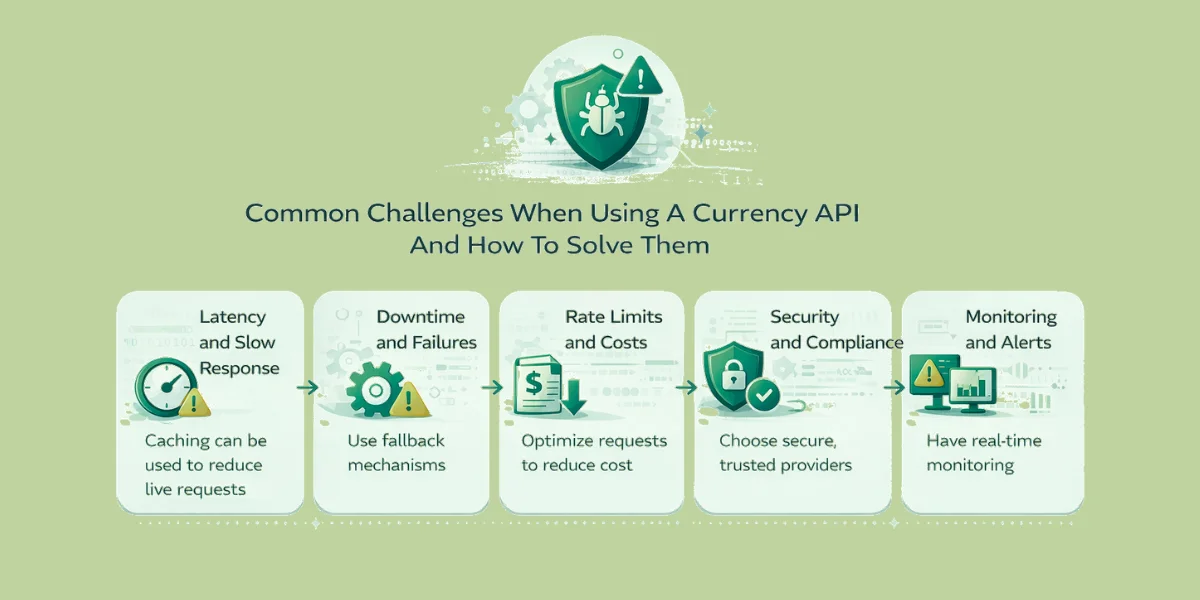
Even the best Currency APIs have technical challenges. You have to plan the security risks, latency, and downtime in businesses. The proactive approach means stability, performance, and customer confidence.
-
Latency and Slow Response: Caching can be used to reduce the number of live requests and enhance the speed of checkouts.
-
Downtime and Failures: Fallback mechanisms, such as stale cache and secondary APIs, must be used.
-
Rate Limits and Costs: Monitor use and optimize requests to reduce the cost.
-
Security and Compliance: Choose the providers with a high degree of encryption and authentication.
-
Monitoring and Alerts: Have real time monitoring so as to detect problems at an early stage.
Helpful Resource: Optimize API Usage: How to Reduce Monthly Calls with Symbols & Base Parameters
TL;DR
-
Accuracy: No more losing money on outdated exchange rates.
-
Automation: Automatically convert local currencies for the customers.
-
Data: Have access to historical data to audit and quarterly briefing reports.
-
Speed: Intuitive APIs are used to integrate easily.
-
Security: Enjoy the benefit of SSL encryption and good uptime.
Conclusion
In the globalized economy, it is important to deal with more than one currency. International customers and dynamic pricing require the support of the business. Real-time data enhances accuracy and decision-making.
Currency API offers quality exchange rates and automation. It assists businesses to grow rapidly and to work with confidence. This minimizes the amount of manual labor and mistakes.
It also shields against market fluctuations and unexpected price variations. Teams acquire information, enhanced management, and trust. The long-term success is supported by investing in the real time currency technology.
FAQs
Can I Use A Currency API For Commercial Use?
Yes, the majority of them permit commercial usage. But, in order to do so, you typically require a paid plan. Never use without checking the pricing and licensing.
What Format Does The Response Come In?
Currency APIs mostly return data in XML or JSON. JSON has been chosen since it is lightweight and can be easily read. XML continues to be utilized in part of the enterprise systems.
Is There A Limit On API Requests?
Yes, restrictions are based on your subscription. These are typically quotas, which are monthly or daily. Keep a check on the usage to prevent additional expenditure or service disruption.
How Often Is The Data Updated?
The frequency of updates depends on the plan. Free plans can be updated every 24 hours. Paid levels can provide real time or hourly updates.


