

Suppose that you are operating an international e-commerce store in 2026. An international customer accesses your product page. They view prices in USD and hesitate to make purchases.
They are wondering about the hidden charges and exchange rates. They do not know the actual price in euros. Such little uncertainty brings resistance and cart abandonment.
You require a quick currency exchange. Paper updates are dangerous and obsolete. Real-time exchange data emerges as a business necessity.
This blog describes how the Exchange Rates API addresses scaling problems. We deconstruct the what, why, and how of API integration. You will also find real life applications, as well as historical and real time rate management.
What Is An Exchange Rates API?
An Exchange Rates API is a collection of api endpoints. It enables developers to access exchange rate data in a programmatic manner. Your code sends a request instead of checking a bank manually.
The service gives back currency conversion rates. These values are derived by reference to sources such as the European Central Bank. You receive information on fiat currencies, metals, and even crypto.
A majority of the reliable providers provide data in XML or JSON. This simplifies the integration of APIs in any modern-day business. This data may be accessed with a special api key.
Why Does Your Business Need A Currency API?

In 2026, business is borderless. Failure to display local rates will cost you clients. Currency api will make sure that your pricing is accurate.
It will assist you in managing the risk of market fluctuation. You are able to automate transactions. This is cost-saving and minimization of human error.
The confidence in a currency exchange rates api also creates trust. The end user is presented with the settlement currency. No more hidden charges or surprises at the checkout.
Helpful Resource: 10 Best Currency Exchange API Options for Developers
Top 10 Applications Of Exchange Rates API In 2026
The foreign exchange environment has been altered. The following are the ten best ways to implement an Exchange Rates API this year. These ideas can be applied to apps of any scale.
1. Shopify: Automatic Localized Pricing
Shopify relies on exchange rate APIs in its Shopify Markets feature. It translates the base price of the merchant to the local currency of the customer immediately. This eliminates the frustration of checkout and avoids sticker shock.
2. QuickBooks & Xero: Multi-Currency Reconciliations
QuickBooks and Xero fetch mid-market rates on a daily basis via APIs. Companies charge using foreign currencies, but record their financial statements in their home currency. Unrealized gains and losses are also automatically recorded under the system using an exchange rates api.
3. Revolut: Instant In-App Currency Swaps
Revolut uses high-frequency exchange rates api. The rates are updated within the application every couple of seconds. When users tap Exchange, they can see the exact price they will get.
4. Wise: Guaranteed Rate Locks
Wise uses real time APIs to lock exchange rates api. When a transfer begins, the rate remains constant for a short time. This will ensure that the beneficiary gets the amount that was promised.
5. Tipalti: Global Automated Payroll
Tipalti uses exchange rate APIs to make mass global payments. The companies invest in USD and are spread in different currencies instantly. The system makes accurate conversions of hundreds of contractors simultaneously.
6. Booking.com: Dynamic Travel Estimates
Booking.com displays the approximate prices in the traveler's currency. The local currency is the currency that the hotel can charge. Billing surprises are avoided by real-time exchange data using an exchange rates api.
7. Robinhood & eToro: Global Asset Valuation
APIs Exchange rate investment apps like Robinhood & eToro are used to value international holdings. Market stocks and crypto are reconciled to a market reporting currency. The portfolio totals are updated as the prices of assets and FX rates are changed.
8. Airbnb: Dual-Sided Localized Payments
Airbnb bridges the hosts and guests in different currencies. Local currency is used by hosts and foreign currency by the guests. The exchange rates api guarantees that the parties obtain correct amounts.
9. PayPal & Stripe: Crypto-to-Fiat Settlement
Exchange rate API settlements are applied in payment gateways such as PayPal & Stripe. Bitcoin transactions are immediately converted to USD or EUR. Merchants do not have to deal with crypto volatility. A foreign exchange rate api enables this process seamlessly.
10. SAP Business One: Corporate Treasury & Hedging
Enterprise ERP systems such as SAP Business One have an exchange rates api and free api exchange rates in risk management. There is real-time and historical currency exposure that is monitored by CFOs. This assists businesses in protecting against market risks.
Comparing Exchange Rates API Pricing Plans
The selection of the appropriate plan is dependent on the usage. The CurrencyFreaks pricing structure is as shown below. It is better to start small and expand.
| Plan Name | Monthly Cost | Updates Option | Key Features |
|---|---|---|---|
| Developer | Free | 24 Hours | 1,000 api requests |
| Starter | $9.99 | Hourly | Historical data |
| Growth | $49.99 | 10 Minutes | IP to Currency |
| Professional | $99.99 | 60 Seconds | Fluctuation endpoint |
Helpful Resource: Exchange Rates API Vs. CurrencyFreaks | Which API is Right For You?
How To Use The Exchange Rates API: A Technical Guide
Now we will take a look at how to implement this. We are going to implement the CurrencyFreaks service. It is characterized by seamless integration.
Step 1: Get Your API Key
First, sign up for an account. You will receive a special key known as an api key. Do not post this on a public client side code.
Step 2: Fetch Latest Rates
You make a GET request to receive the latest rates. The following is a Python example of usd as the base. The same pattern can be used in any backend.
import requests

# Set your API Key

API_KEY = "YOUR_API_KEY"

url = f"https://api.currencyfreaks.com/v2.0/rates/latest?apikey={API_KEY}"

# Send the request

response = requests.get(url)

if response.status_code == 200:

    data = response.json()

    print(f"Base Currency: {data['base']}")

    print(f"EUR Rate: {data['rates']['EUR']}")

else:

    print("Error fetching data")
Here's the output
Base Currency: USD
EUR Rate: 0.8415
Step 3: Historical Data Retrieval
There are occasions when the rate for a certain date is needed. This is made possible by the foreign exchange rates api. All you have to do is add the date to your request.
// Fetching historical rates for 2022-01-10

const apiKey = 'YOUR_API_KEY';

const date = '2022-01-10';

const url = `https://api.currencyfreaks.com/v2.0/rates/historical?apikey=${apiKey}&date=${date}`;

fetch(url)

  .then(res => res.json())

  .then(json => console.log(json.rates['GBP']));
Here's the output
0.735835
Advanced Features Of The Exchange Rates API
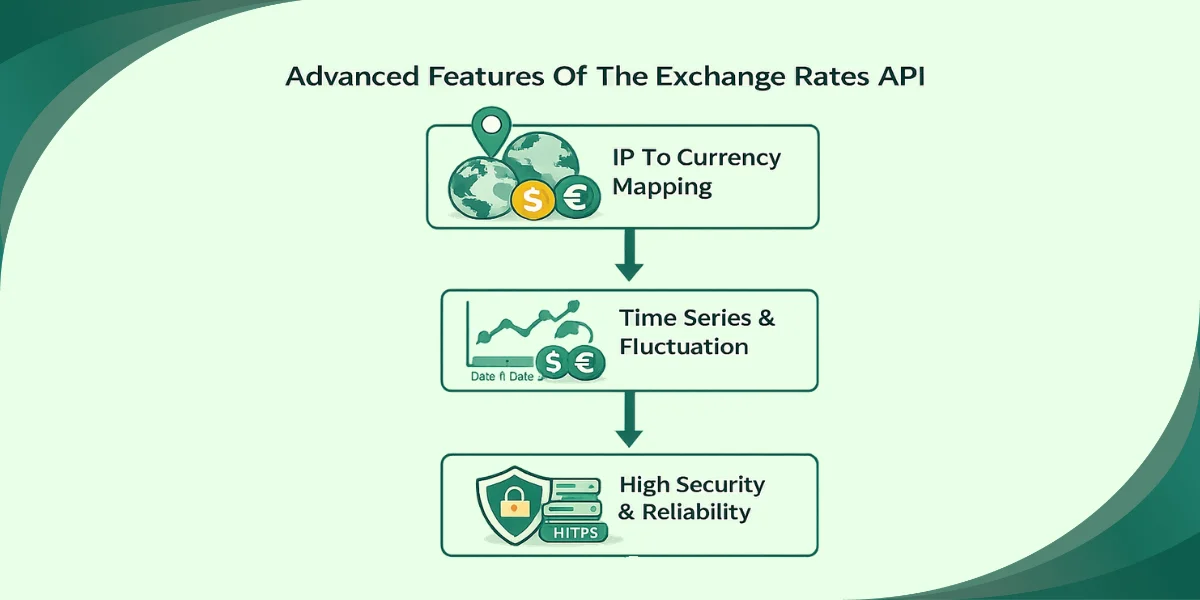
IP To Currency Mapping
It is a high-quality feature. The api identifies the position of the visitor. Then it proposes the appropriate currency code. This simplifies the user processing.
Time Series And Fluctuation
Have to check the movement of the euro versus the usd? Use the Time Series endpoint. It gives a list of rates at two dates. It is ideal for chart construction.
High Security and Reliability
SSL is being used to encrypt all api requests. This applies even at the free currency exchange rate api tier. CurrencyFreaks relies on geolocation routing in order to achieve 20-40 ms latency.
Why CurrencyFreaks Is The Best Choice In 2026
The free exchange rates API has a lot of options. However, CurrencyFreaks is different. It supports 1011 currencies.
This consists of 171 fiat, 4 metals, and 836 cryptos. They provide platinum services to the high-end users. You have a quarterly update with the product management team and can also share priority roadmap input.
This gives you the ability to give feature requests directly. The exchange rates api documentation is clear. It also has examples in Java, PHP, Ruby, and Swift, making it a strong alternative to bloomberg api currency exchange rates.
The support is great, whether you are an independent developer or a giant company using api exchange rates. You are able to ship at a higher speed with fewer surprises. You are also getting good coverage in markets.
Key Considerations For API Usage
The following are tips to consider before deploying the Exchange Rates API:
-
Rate Limits: Be familiar with your monthly quota. When you go beyond it, the api has a 429 error. Plan around peaks.
-
Caching: Cache exchange rates api rates locally for several minutes. This saves on api requests. It also improves speed.
-
Base Currencies: In the free plan, the default is typically usd. Paid plans enable alteration of the base. Select what your billing logic wants with an exchange rates api.
-
Error Handling: Never neglect to look at the status code of the response. Include retries in case of temporary failures. Log errors for debugging.
TL;DR
-
What: The tool to retrieve the correct exchange rate information. It sends rates through endpoints. It works fast in apps.
-
Why: To localize prices, automate payroll, and eliminate hidden fees professional level. It builds trust at checkout. It also reduces manual work.
-
How: Basic REST api communication in either JSON or XML. You use an api key to authenticate. You make the latest or historical calls. You can also schedule a quarterly briefing call to review performance and updates.
-
Who: Developers and business owners expanding internationally. Product teams use it for UX. It is utilized by finance teams to be precise.
-
Best Alternate: CurrencyFreaks because of speed and coverage. It supports 1011 currencies. It offers a free exchange rate api to Pro plans.
Conclusion
The Exchange Rates API forms the foundation of worldwide technology in 2026. It eliminates the foreign exchange barriers. It enables developers to create more intelligent and localized apps.
With an effective service provider, you can guarantee your clients the best value. You can access real time exchange rate and historical information easily, including through a Power BI exchange rate api. It maintains your prices at the same level.
Do not allow the manual updates to delay you. Install an api for exchange rates and concentrate on what is important, on expanding your business. The world market is offering you a limitless opportunity, especially when your system also supports product management feature requests.
FAQs
How To Calculate PayPal Exchange Rate With Euro API?
PayPal normally provides an increment to the market rate. Get the EUR mid-market rate with the exchange rate api free, and compare it to the PayPal displayed rate at checkout. The hidden fee is actually the gap.
How To Get Exchange Rates API?
Register with a provider to receive a key for your API. CurrencyFreaks requires you to create an account, open the dashboard, and copy your key. Then you are able to test the requests on the free tier and upgrade as you scale.
What is the Exchange Rate API?
An exchange rate API provides currency exchange rates via endpoints. Real-time or past rates can be fetched by your app using central banks or market feeds that are trusted. It assists you in pricing, paying out, and reporting in different currencies.
How Often Should You Update Exchange Rates In Your App?
It is based on your usage case and risk. Hourly, e-commerce can be updated, whereas in the case of trading or wallets, this can be performed every minute. Caching can be used to balance between accuracy and API expenses.
What Is The Best Way To Store And Cache Exchange Rates?
Redis cache rate in memory or your own database with a short TTL. Also, refresh in the background and not on each user request. This makes your application quick and saves 429 rate-limit errors.
Can You Convert Multiple Currencies In One API Request?
Yes, most exchange rate APIs will give a complete rate table of a given base currency. That single reply can convert currencies. It is quicker than invoking the API by given currency pair.
How Accurate Are Exchange Rates Provided By An API?
The majority of exchange rates api providers rely on reputable financial sources. Central bank or aggregated market feeds are normally the source of rates. Precision relies on the frequency of updates and the reliability of the providers.
What Happens If The Exchange Rates API Goes Down?
Good uptime guarantees are provided by reliable providers. Cached exchange rates api data should be used as a backup in your system. Heavy disruptions are avoided by the use of retry logic and monitoring.


