

Imagine a customer visiting your e-commerce store in Paris. They get ideal boots, but the price is expressed in USD only. They stop and begin searching for currency exchange rates. At this point, the purchasing mood goes away.
This resistance kills conversions. A convert currency API eliminates this obstacle. It displays local prices in real-time. Global brands must have real-time exchange rates. They enhance trust and build user confidence. They also boost sales and interactions.
In this guide, you will learn how to select the appropriate currency API. We will address historical information and IP-to-currency localization. Let us make your global application local.
What Is A Convert Currency API?
A currency conversion API is a web-based service. It allows currency developers to have instant access to real-time currency information.
The currency API your app uses is linked to trusted providers, which makes your system fast and accurate.
These intuitive APIs will return responses in JSON or XML format. They assist in major currencies such as USD and EUR. They consist of precious metals and cryptocurrencies as well.
Reliable financial information is guaranteed by a trusted provider. This minimizes risks in financial transactions. It also enhances the world's credibility.
Why Is It Essential For Modern Apps?
If you have an e-commerce store, you are serving customers worldwide. Buyers demand transparency and fair prices. They do not like hidden fees and unpredictable exchange rates.
Real-time localized pricing enhances confidence. It helps customers make decisions quickly. This creates high trust and loyalty.
This is the feature that product management teams prioritize. It will help minimize cart abandonment and confusion. A currency conversion API also supports this process by ensuring accurate, up-to-date price display. It also enhances international conversion rates.
The user experience should be maintained. There should be consistency in the display of currency values.
Helpful Resource: Why Businesses Are Switching From the Google Currency Exchange Rate API to Better APIs
Core Features Of A Professional Currency API
-
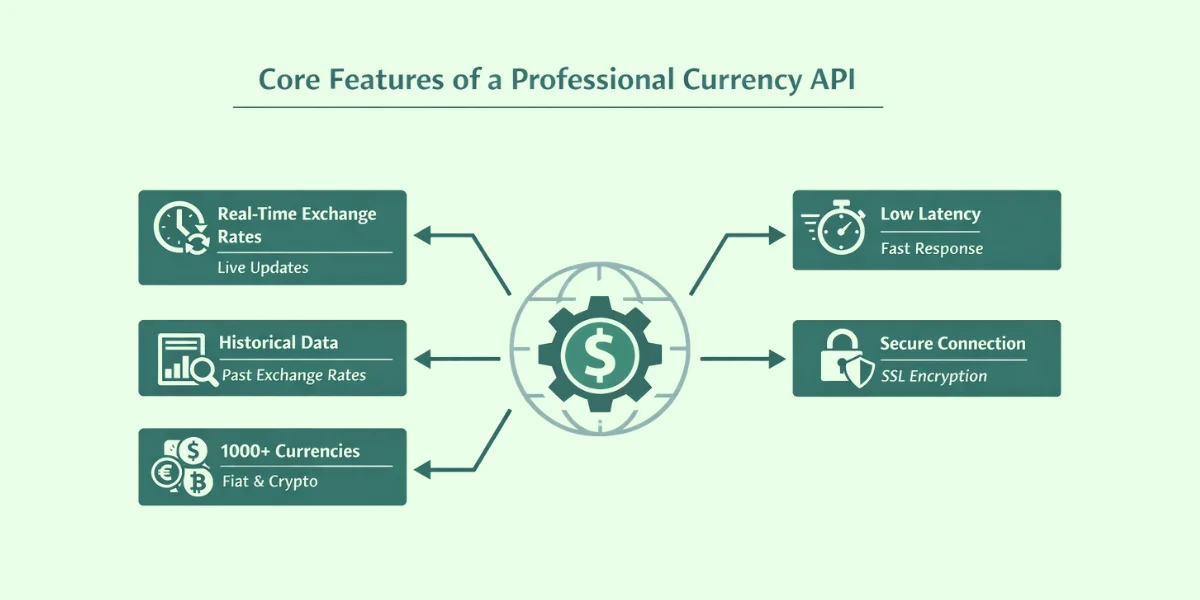
Real-Time Exchange Rates: Updates should be frequent (e.g., hourly or even every 60 seconds).
-
Historical Data: Availability of historical exchange rates in terms of auditing or price trend analysis.
-
Support 1000+ Currencies: Fiat, crypto, and precious metal coverage.
-
Low latency: High speed (20-40ms) ensures your UX isn't laggy.
-
Secure Connection: API calls must be encrypted using SSL.
Best Practices For Choosing The Right Convert Currency API
The currency conversion API has to be carefully chosen. Not every provider is equally accurate and fast. Reliability, security, and scalability should be compared.
Always verify data sources and their update frequency. Live time exchange rates enhance trust and transparency. A quick response is also key to user experience.
Global apps are also of great importance for security. Make sure that the api is encrypted and secure. This safeguards the financial information and creates user trust.
Helpful Resource: How to Choose the Right API for Currency Exchange: Key Factors
Comparison Of Subscription Tiers
| Feature | Developer (Free) | Starter | Professional | Enterprise |
|---|---|---|---|---|
| API Requests/Month | 1,000 | 15,000 | 550,000 | Custom |
| Update Frequency | 24 Hours | Hourly | 60 Seconds | 60 Seconds |
| Base Currencies | USD Only | All | All | All |
| Historical Data | No | Yes | Yes | Yes |
| Support Team | Limited | Basic | Platinum Support | Platinum Support |
How To Integrate A Convert Currency API
The process is easy to follow.
Most of the modern apps are compatible with this method. It also supports web and mobile systems. It can be deployed without complicated configuration.
1. Get Your API Key
To start with, register for a free or paid plan. After registering, you will be given a special key for your API. This is used to keep track of your usage and authenticate your api requests.
Keep your API key secure. Do not leave it in the open repositories when using a currency conversion API. It should always be stored in the environment variables.
2. Make An API Call
The endpoints can be tested in a Postman collection. Or you may write a little script. Below is a practical example. It utilizes a currency converter API endpoint that converts USD to PKR.
Test your integration in a staging environment. This assists you in escaping unforeseen problems. It also guarantees hassle-free deployment of production.
Code Example: Real-Time Currency API Integration in JavaScript
Here’s how you can integrate a convert currency API in your app in minutes:
// Example: Converting 500 USD to PKR using CurrencyFreaks API

const apiKey = 'YOUR_API_KEY';

const from = 'USD';

const to = 'PKR';

const amount = 500;


fetch(`https://api.currencyfreaks.com/v2.0/convert/latest?apikey=${apiKey}&from=${from}&to=${to}&amount=${amount}`)

  .then(response => response.json())

  .then(data => {

    console.log(`Converted Amount: ${data.convertedAmount} ${to}`);

    console.log(`Current Rate: ${data.rate}`);

  })

  .catch(error => console.error('Error:', error));
Here's the output
Converted Amount: 139250 PKR
Current Rate: 278.50
3. Handle The Response
The api is based on JSON. You will receive a response. It has the exchange rate data, the given amount, and the converted amount.
This assists in displaying the final cost. It is immediately visible to your customers.
An exchange rate API can also be used to format the response. Show localized currency symbols. This enhances the user experience.
Helpful Resource: Currency Exchange API Integration: A Step-by-Step Guide for Developers
Enhancing UX with IP To Currency Localization
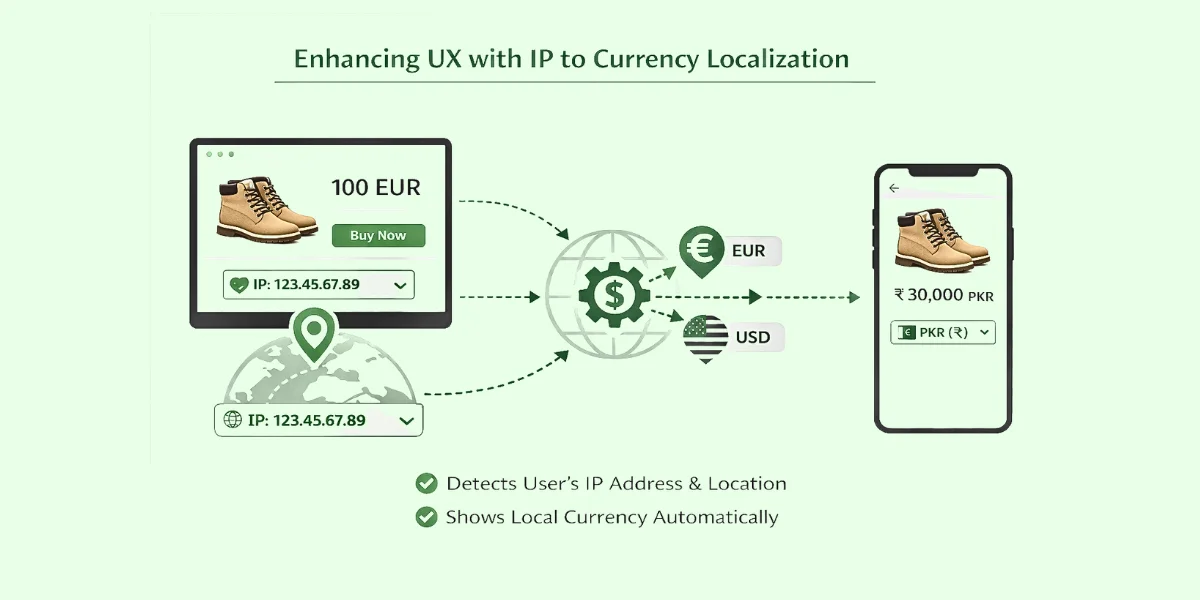
The IP-to-currency endpoint is one of the most optimal endpoints of CurrencyFreaks. It will identify the user's position based on their IP address. It then displays automatic conversion rates of local currency.
You do not have to inquire of users where they belong. The service determines the country and provides the appropriate currency code. This enhances ease and minimizes friction within international applications.
This is used by international brands to make foreign exchange rates easier for their customers. This helps us build trust and enhance conversions.
Tip: It is always best to send the users a manual currency option. In some cases, the IP detection can be faulty. It has a simple update functionality that provides flexibility and increased user satisfaction.
Dealing With Historical Data And Fluctuations
In some cases, a company requires more than the current rates. Many billing systems require historical data. Checking the exchange rate three months ago might be required.
The historical exchange rates endpoint assists you in searching using specific dates. It gives consistent statistics dating back to 1984. A reliable exchange rate API helps in making the reporting and audits easier.
Further, the fluctuation endpoint favors financial dashboards. It displays the opening rate, final rate, and the percentage change. This assists the users in monitoring the exchange rates.
These are important insights in commercial decision-making. Businesses can keep track of risk and plan budgets. It also enhances long-term financial planning.
Future Trends In Currency Conversion And Global Payments
Currency conversion rates are getting smarter in the future. The world is changing payments with the help of AI and automation. There is now predictive and real-time pricing demanded by businesses.
The use of digital wallets and fintech is expanding at a fast pace. The users demand real-time cross-border transactions.
Exchange systems are also being affected by blockchain and decentralized finance. These technologies enhance transparency and minimize delays in transacting.
TL;DR
-
Precise Data: Obtained via the European Central Bank and key exchanges.
-
Scalable: Free is used to test, and platinum support click levels are offered to enterprises.
-
Globalization: Supports 1026 world currencies, including crypto.
-
Developer Friendly: API documentation and easy code samples.
-
Fast: Routing with geo location to achieve ultra-low latency.
Conclusion
Enhancement of UX in international apps is no longer a choice. International sales cannot be made without it. An exchange rate API eliminates brain math and enhances understandability.
It provides a smooth and professional user experience. The customers have confidence in the transparent pricing of their currency, especially when supported by insights based on their location. This generates trust and minimizes cart abandonment.
The right currency conversion API helps businesses grow, whether you are a global enterprise or a startup. Localize now to open up global opportunities.
FAQs
Is There A Limit On API Requests For A Convert Currency API?
Yes. Each plan has a monthly request limit. The free plan provides 1,000 requests, whereas the Professional plan allows 550,000 requests. This helps you test and scale your real-time currency API usage effectively.
How Can I Integrate A Convert Currency API For Real-Time Exchange Rates?
You can integrate the API using your unique API key. Use the provided JavaScript code snippet, Postman collection, or server-side scripts to fetch live currency data in your app.
Does The API Support Multiple Programming Languages?
Yes. The API response is in JSON or XML and is compatible with Python, PHP, Ruby, Java, and JavaScript. This makes it easy to use in web and mobile apps.
Are There Any Hidden Fees At The Professional Or Paid Levels?
No. Pricing is transparent for all plans. Annual billing is available at a discount, and there are no hidden charges when using the currency conversion API.
How Often Is The Currency Data Updated In This API?
Update frequency depends on your plan: free plan updates every 24 hours, starter plan updates hourly, and professional/enterprise plans provide real-time updates every 60 seconds.
Does The API Offer IP-To-Currency Localization?
Yes. The IP-to-currency endpoint automatically detects a user’s location and displays local currency. This reduces friction and enhances the user experience in international apps.
Can I Access Historical Exchange Rates With This Currency API?
Yes. You can retrieve historical exchange rates to support audits, financial dashboards, or billing systems. Some APIs provide data going back decades for accurate trend analysis.


